Types of sentences
Sentences are grouped two ways: by purpose (to state, ask, order, exclaim or wish) and by structure (simple, compound, complex, compound-complex). Here is every type, with examples, a chart and a quiz.
- 5 types by purpose and 4 by structure, each with examples
- A chart of all nine to download (PNG or PDF)
- How to identify and change them, a quiz and a 20-sentence exercise
Knowing the types helps with three things: punctuating correctly, changing one type into another (a common school exercise), and writing with variety, which every writing test rewards.
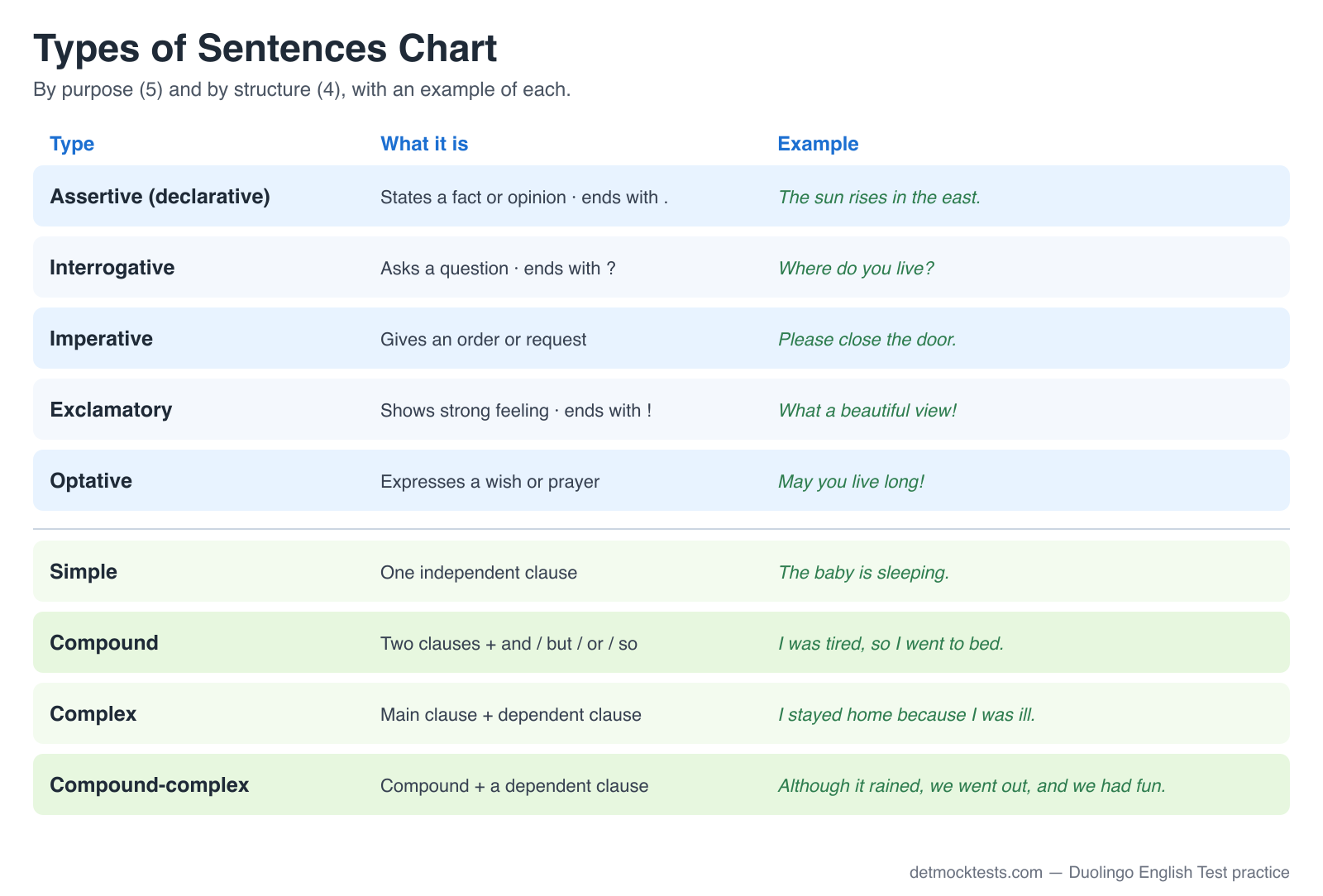
All nine types of sentences
| Type | What it is | Example |
|---|---|---|
| Assertive sentence | States a fact or opinion. It can be affirmative or negative. | The sun rises in the east. |
| Interrogative sentence | Asks a question: yes/no questions, wh- questions, choice questions and tag questions. | Where do you live? |
| Imperative sentence | Gives an order, request, advice or instruction. The subject (you) is usually left out. | Close the door. |
| Exclamatory sentence | Shows strong feeling: surprise, joy, anger or sorrow. Often starts with What or How. | What a beautiful view! |
| Optative sentence | Expresses a wish, prayer or blessing. Often starts with May. | May you live long! |
| Simple sentence | One subject and one verb (either can be doubled), expressing one complete idea. | Ravi and Meena play tennis. |
| Compound sentence | Two or more independent clauses joined by a coordinating conjunction (for, and, nor, but, or, yet, so) or a semicolon. | She likes tea, but he prefers coffee. |
| Complex sentence | One independent clause and at least one dependent clause, joined by a subordinating word (because, although, when, if, who, which, that). | When the bell rang, the students left. |
| Compound-complex sentence | A compound sentence with a dependent clause added. | I called her because I was worried, but she did not answer. |
Kinds of sentences by purpose (5)
What the sentence is for: to state, to ask, to order, to exclaim or to wish.
Assertive sentence (declarative sentence)
States a fact or opinion. It can be affirmative or negative. It ends with a full stop (.).
- The sun rises in the east.
- My brother works in a bank.
- She does not eat meat.
- Delhi is the capital of India.
- I have never seen snow.
Interrogative sentence (question)
Asks a question: yes/no questions, wh- questions, choice questions and tag questions. It ends with a question mark (?).
- Where do you live?
- Have you finished your homework?
- Would you like tea or coffee?
- Why is the shop closed?
- You are coming, aren’t you?
Imperative sentence (command or request)
Gives an order, request, advice or instruction. The subject (you) is usually left out. It ends with a full stop, or ! for a strong order.
- Close the door.
- Please sit down.
- Turn left at the bank.
- Don’t touch the wire!
- Take an umbrella with you.
Exclamatory sentence (exclamation)
Shows strong feeling: surprise, joy, anger or sorrow. Often starts with What or How. It ends with an exclamation mark (!).
- What a beautiful view!
- How fast she runs!
- What a mess this is!
- Hurrah, we won!
- How kind of you!
Optative sentence (wish or prayer)
Expresses a wish, prayer or blessing. Often starts with May. It ends with a full stop or !.
- May you live long!
- May God bless you.
- Wish you a happy birthday!
- May your dreams come true.
- Long live the king!
Types of sentences by structure (4)
How the sentence is built: how many clauses, and how they are joined. An independent clause can stand alone (“I was tired”); a dependent clause cannot (“because I was tired”).
Simple sentence
Pattern: one independent clause. One subject and one verb (either can be doubled), expressing one complete idea.
- The baby is sleeping.
- Ravi and Meena play tennis.
- She sings and dances.
- We waited for an hour.
Compound sentence
Pattern: independent clause + FANBOYS + independent clause. Two or more independent clauses joined by a coordinating conjunction (for, and, nor, but, or, yet, so) or a semicolon.
- I was tired, so I went to bed.
- She likes tea, but he prefers coffee.
- You can walk, or you can take the bus.
- The rain stopped; the match began.
Complex sentence
Pattern: independent clause + dependent clause. One independent clause and at least one dependent clause, joined by a subordinating word (because, although, when, if, who, which, that).
- I stayed at home because I was ill.
- When the bell rang, the students left.
- The book that you lent me is excellent.
- Although it was late, we kept working.
Compound-complex sentence
Pattern: two independent clauses + at least one dependent clause. A compound sentence with a dependent clause added.
- Although it was raining, we went out, and we had a great time.
- I called her because I was worried, but she did not answer.
- The film that we saw was long, yet nobody left early.
| Joining words | Make a… | Examples |
|---|---|---|
| for, and, nor, but, or, yet, so (FANBOYS) | compound sentence | and, but, or, so |
| because, although, when, while, if, unless, since, until, after, before | complex sentence (adverb clause) | I left because it was late. |
| who, whom, whose, which, that | complex sentence (relative clause) | The man who called is my uncle. |
| that, what, whether, how | complex sentence (noun clause) | I know that you are right. |
Changing one type of sentence into another
| Change | Before | After |
|---|---|---|
| Assertive → interrogative | She is ready. | Is she ready? |
| Assertive → negative interrogative (same meaning) | Everyone loves a holiday. | Who does not love a holiday? |
| Assertive → exclamatory | It is a very beautiful flower. | What a beautiful flower it is! |
| Exclamatory → assertive | How hot it is! | It is very hot. |
| Imperative → assertive | Please help me. | I request you to help me. |
| Simple → compound | Being tired, I went to bed. | I was tired, so I went to bed. |
| Simple → complex | In spite of the rain, we played. | Although it rained, we played. |
| Compound → complex | Work hard and you will pass. | If you work hard, you will pass. |
How this shows up on the Duolingo English Test
Sentence types are part of the grammar range every DET writing and speaking task rewards:
| DET task | How sentence types helps |
|---|---|
| Write About the Photo | One complex sentence (“A boy waits at the bus stop while his mother checks her phone.”) shows more range than two simple ones. |
| Interactive Writing and the Writing Sample | A mix of simple, compound and complex sentences reads as controlled, varied writing. |
| Interactive Speaking | You must understand questions (interrogatives) instantly and answer with a full statement. |
| Interactive Reading | Long complex sentences in passages are easier when you can find the main clause. |
Put it under exam conditions with a full Duolingo English Test mock, or drill single question types from the question-type guides.
Types of sentences quiz
Name the type of each sentence. The options are from the same group, so purpose is tested against purpose and structure against structure.
Identify the type of sentence: exercise with answers
Name the type of each sentence (by purpose for 1–5 and 10–12, 16–17, 19–20; by structure for the rest). Then open the answers.
- Open your books to page ten.
- Did you see the match last night?
- What a clever idea!
- May you have a safe journey.
- The train leaves at six.
- She was hungry, so she made a sandwich.
- I will call you when I reach home.
- The dog barked loudly.
- Because it was raining, the match was stopped, but the crowd stayed.
- How quickly the year has passed!
- Where is the nearest post office?
- Please wait here.
- Rahul and Priya are cousins.
- The girl who won the prize is my friend.
- You can stay, or you can leave now.
- He does not like spicy food.
- Long live our friendship!
- Although she was nervous, she spoke clearly.
- Never tell a lie.
- Can you help me with this bag?
Show the answer key
- Imperative
- Interrogative
- Exclamatory
- Optative
- Assertive
- Compound
- Complex
- Simple
- Compound-complex
- Exclamatory
- Interrogative
- Imperative
- Simple
- Complex
- Compound
- Assertive (negative)
- Optative
- Complex
- Imperative
- Interrogative
Types of sentences: quick reference
| Question | Answer |
|---|---|
| Types by purpose | Assertive, interrogative, imperative, exclamatory, optative. |
| Types by structure | Simple, compound, complex, compound-complex. |
| Assertive (declarative) | States something; ends with a full stop. |
| Interrogative | Asks; ends with a question mark. |
| Imperative | Orders or requests; “you” is understood. |
| Exclamatory | Strong feeling; ends with ! |
| Optative | A wish or prayer: “May you…” |
| Compound | Two independent clauses + for, and, nor, but, or, yet, so. |
| Complex | Main clause + dependent clause (because, when, if, who). |
| Compound-complex | Two independent clauses + a dependent clause. |
Types of sentences: your questions
What are the types of sentences?
By purpose, there are four (or five): assertive (declarative), interrogative, imperative, exclamatory and, in many Indian textbooks, optative. By structure, there are four: simple, compound, complex and compound-complex. The chart on this page shows all nine with an example.
What are the 4 types of sentences?
By purpose: declarative (states something: “The shop is open.”), interrogative (asks: “Is the shop open?”), imperative (orders or requests: “Open the shop.”) and exclamatory (shows feeling: “What a big shop!”). By structure, the four are simple, compound, complex and compound-complex.
What are the 5 kinds of sentences?
Assertive, interrogative, imperative, exclamatory and optative. The fifth, optative, expresses a wish or prayer (“May you live long!”). Many grammar books outside India count only the first four and treat wishes as exclamatory or imperative. If an exam asks for five kinds, include optative; if it asks for four, leave it out.
What is an interrogative sentence?
A sentence that asks a question and ends with a question mark: “Where do you live?”, “Have you eaten?”, “Tea or coffee?”. It usually starts with a helping verb (is, do, have, can) or a question word (what, where, why, how).
What is an imperative sentence?
A sentence that gives an order, request, advice or instruction: “Close the door.”, “Please sit down.”, “Turn left.” The subject you is understood rather than written, and it usually ends with a full stop (or ! for a strong command).
What is an exclamatory sentence?
A sentence that expresses strong feeling and ends with an exclamation mark: “What a beautiful view!”, “How fast she runs!”. Many start with What (+ a noun) or How (+ an adjective or adverb). In formal writing, avoid exclamation marks used only for emphasis.
What is an assertive sentence?
A sentence that states a fact, belief or opinion, and ends with a full stop. It can be affirmative (“She speaks French.”) or negative (“She does not speak French.”). It is also called a declarative sentence. Most sentences in essays and reports are assertive.
What is an optative sentence?
A sentence that expresses a wish, prayer or blessing: “May you live long!”, “May God bless you.”, “Long live the king!”. It often begins with May and can end with a full stop or an exclamation mark. It is mostly used in formal speech, prayers and greetings.
What is a simple sentence?
A sentence with one independent clause: one subject and one verb, expressing one complete thought. “The baby is sleeping.” It can still have a double subject or verb: “Ravi and Meena play tennis.”, “She sings and dances.” Simple does not mean short: “The old man in the blue coat walked slowly down the road” is still one clause.
What is a compound sentence?
Two or more independent clauses joined by a coordinating conjunction (for, and, nor, but, or, yet, so, remembered as FANBOYS) or a semicolon: “I was tired, so I went to bed.” Each clause could stand alone as a sentence. Put a comma before the conjunction, especially when the clauses are long.
What is a complex sentence?
One independent clause plus at least one dependent clause, joined by a subordinating word such as because, although, when, if, who, which or that: “I stayed at home because I was ill.” The dependent clause cannot stand alone. If the dependent clause comes first, put a comma after it: “Because I was ill, I stayed at home.”
What is a compound-complex sentence?
A sentence with at least two independent clauses and at least one dependent clause: “Although it was raining, we went out, and we had a great time.” It combines the joining of a compound sentence with the dependent clause of a complex one.
What is the difference between assertive and declarative sentences?
None: they are two names for the same type, a sentence that states something. Indian textbooks usually say assertive; British and American books usually say declarative. Use the name your textbook or exam uses; the definition is the same.
How do I identify the type of a sentence?
For purpose, look at what it does and how it ends: a statement (.), a question (?), an order (no subject), a strong feeling (!) or a wish (May…). For structure, count the clauses: one = simple; two joined by and/but/or/so = compound; one with because/when/if/who = complex; both = compound-complex.
How do I change an assertive sentence into an interrogative one?
Move the helping verb before the subject, or add do/does/did: “She is ready.” → “Is she ready?”; “He plays chess.” → “Does he play chess?”. To keep the same meaning, schools often use a negative question: “Everyone loves music.” → “Who does not love music?”
Do sentence types matter on the Duolingo English Test?
Yes, in the writing and speaking tasks. Using a mix of simple, compound and complex sentences shows grammatical range, which is part of how Write About the Photo, Interactive Writing and the Writing Sample are graded; and in Interactive Speaking you have to understand questions instantly.
Start a practice test
An hour under real conditions, all eight subscores, and feedback on every written and spoken answer.
Take a test