Active and passive voice
The rules for changing active voice into passive voice, a chart for every tense, examples, the special cases exams test, and exercises with answers.
- Active and passive voice rules, step by step
- A passive voice chart for every tense, to save or print
- Examples, questions, imperatives, modals and exercises
Every sentence with an object can be said two ways. The active voice puts the doer first and is the default in conversation. The passive voice puts the thing affected first, which is why news, science and formal writing use it so often. This page gives the active and passive voice rules, a chart for every tense, examples, the special cases (questions, imperatives, two objects, modals), the mistakes examiners look for, and a quiz and worksheet.
Active and passive voice chart
One verb and object in every tense, so you can see that only the form of be changes.
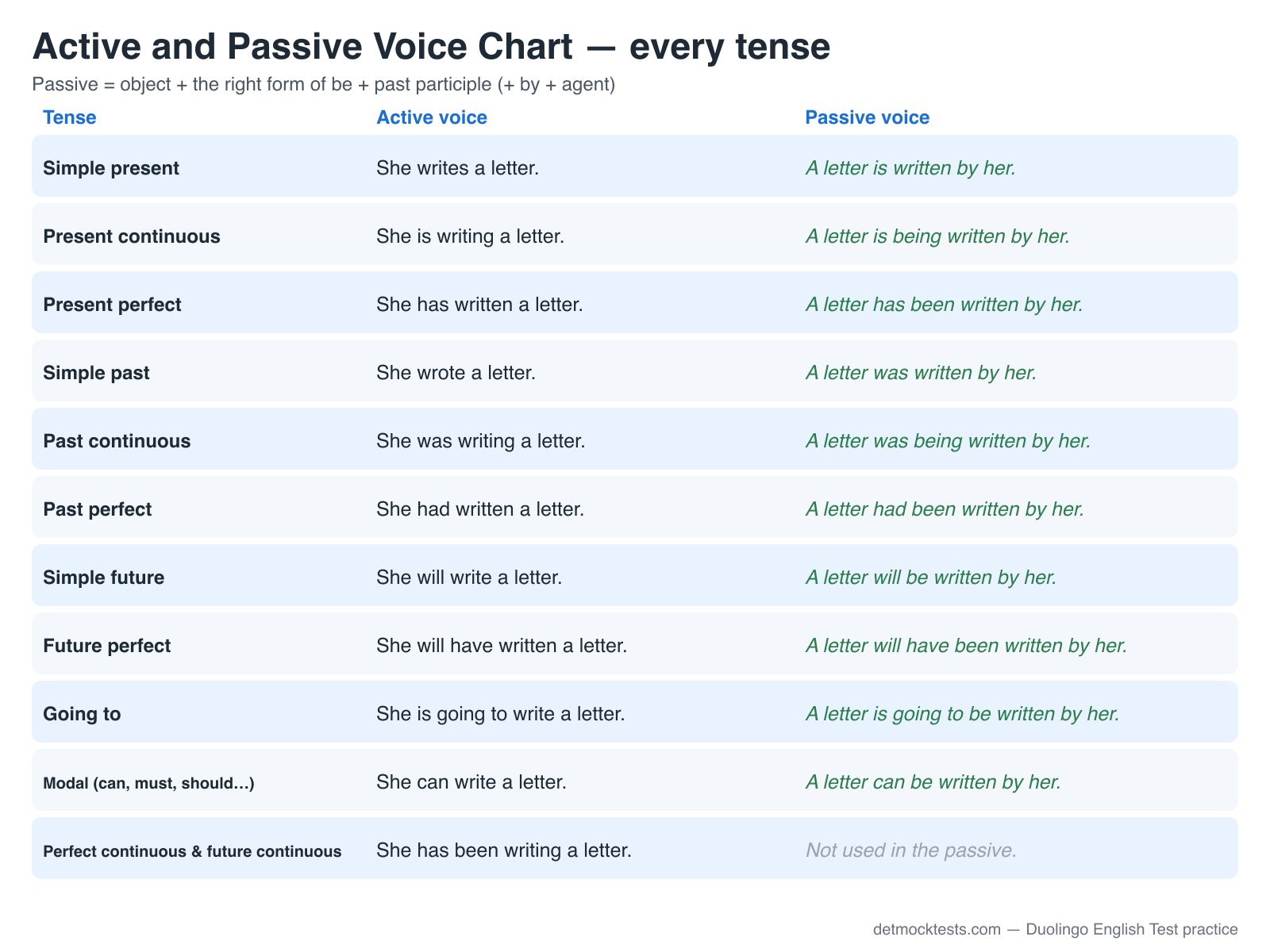
| Tense | Active voice | Passive voice |
|---|---|---|
| Simple present | She writes a letter. | A letter is written by her. |
| Present continuous | She is writing a letter. | A letter is being written by her. |
| Present perfect | She has written a letter. | A letter has been written by her. |
| Simple past | She wrote a letter. | A letter was written by her. |
| Past continuous | She was writing a letter. | A letter was being written by her. |
| Past perfect | She had written a letter. | A letter had been written by her. |
| Simple future | She will write a letter. | A letter will be written by her. |
| Future perfect | She will have written a letter. | A letter will have been written by her. |
| Going to | She is going to write a letter. | A letter is going to be written by her. |
| Modal (can, must, should…) | She can write a letter. | A letter can be written by her. |
| Perfect continuous & future continuous | She has been writing a letter. | Not used in the passive. |
Active and passive voice rules
Find the object
Only a sentence with an object can be made passive. In “The cat chased the mouse”, the object is the mouse.
Make the object the subject
The mouse moves to the front: “The mouse …”.
Use be + past participle in the same tense
The active verb is simple past (chased), so use simple past be (was) + the past participle (chased): “The mouse was chased …”.
Add by + the doer, if it matters
“The mouse was chased by the cat.” Leave it out if the doer is unknown, obvious or unimportant.
Check agreement and pronouns
Be agrees with the new subject (The mice were chased), and a subject pronoun becomes an object pronoun after by.
| Active subject | After by |
|---|---|
| I | me |
| we | us |
| you | you |
| he | him |
| she | her |
| they | them |
| it | it |
Active and passive voice examples
| Active voice | Passive voice |
|---|---|
| The cat chased the mouse. | The mouse was chased by the cat. |
| People speak English all over the world. | English is spoken all over the world. |
| The chef is cooking dinner. | Dinner is being cooked by the chef. |
| Someone has stolen my bike. | My bike has been stolen. |
| The council will build a new library. | A new library will be built by the council. |
| They had finished the work before noon. | The work had been finished before noon. |
| The teacher was checking the papers. | The papers were being checked by the teacher. |
| You must wear a helmet. | A helmet must be worn. |
| Did the manager approve the plan? | Was the plan approved by the manager? |
| Who wrote this report? | By whom was this report written? |
| Close the door. | Let the door be closed. |
| They gave me a prize. | I was given a prize. / A prize was given to me. |
| The storm damaged many houses. | Many houses were damaged by the storm. |
| We are going to paint the room. | The room is going to be painted. |
| The police arrested two men. | Two men were arrested by the police. |
| Students should submit the form by Friday. | The form should be submitted by Friday. |
Questions, imperatives, two objects and modals
| Sentence type | Rule | Example |
|---|---|---|
| Yes/no question | Auxiliary first, then passive | Did they finish it? → Was it finished by them? |
| Wh- question (who) | By whom + passive question | Who wrote it? → By whom was it written? |
| Wh- question (other) | Keep the question word | Why did they cancel the trip? → Why was the trip cancelled? |
| Imperative | Let + object + be + past participle | Close the door. → Let the door be closed. |
| Polite request | You are requested to… | Please wait here. → You are requested to wait here. |
| Two objects | Either object can be the subject | They gave me a prize. → I was given a prize. |
| Modal | Modal + be + past participle | You should check it. → It should be checked. |
| Negative | Not after the first auxiliary | They did not invite him. → He was not invited. |
When to use the passive voice, and when not to
Use the passive when the doer is unknown (“My phone was stolen”), obvious (“The thief was arrested”), or less important than what happened (“The vaccine was tested on 30,000 people”). It is standard in scientific and formal writing, in news, and in notices (“Photography is not permitted”). Use the active when the doer matters or when you want to sound direct: “We tested the vaccine” is clearer than “The vaccine was tested by us”.
Common mistakes with the passive voice
| Wrong | Right | Why |
|---|---|---|
| The book was | The book was written by her. | The passive needs the past participle, not the past simple. |
| The accident | The accident happened. | Happen has no object, so no passive. |
| The letter was sent by | The letter was sent by her. | Object pronoun after by. |
| The windows | The windows are cleaned daily. | Be agrees with the new plural subject. |
| The work | The work will be finished tomorrow. | Keep the tense of the active sentence. |
Voice works with tense: you cannot form a passive without knowing which tense you are in. If the tenses are shaky, start with the English tenses chart.
How this shows up on the Duolingo English Test
No DET task asks you to change voice, but the passive is everywhere in the reading passages and in the grammar you are scored on:
| DET task | How the passive voice helps |
|---|---|
| Interactive Reading | Academic passages lean on the passive (“the data were collected…”); recognising it quickly keeps you on track under the timer. |
| Read & Complete | Damaged auxiliaries and participles (wa_ buil_) are rebuilt from the passive pattern. |
| Writing Sample & Write About the Photo | A well-placed passive shows range in formal writing; “was wrote” and “was happened” cost accuracy. |
Put it under exam conditions with a full Duolingo English Test mock, or drill single question types from the question-type guides.
Which passive tense is it?
Read the sentence and choose the tense of the bold passive verb.
Active and passive voice exercises, with answers
Twelve exercises: active to passive, passive to active, questions, imperatives and error correction.
- Change into the passive: The gardener waters the plants.
- Change into the passive: She is reading a novel.
- Change into the passive: They have completed the project.
- Change into the passive: Ravi broke the window.
- Change into the passive: The company will launch a new phone.
- Change into the passive: Can you solve this problem?
- Change into the passive: Open the window.
- Change into the passive: Who invented the telephone?
- Change into the active: The letter was posted by my brother.
- Change into the active: The song is being sung by the children.
- Correct the error: The book was wrote by a famous author.
- Correct the error: The accident was happened yesterday.
Show the answer key
- The plants are watered by the gardener.
- A novel is being read by her.
- The project has been completed (by them).
- The window was broken by Ravi.
- A new phone will be launched by the company.
- Can this problem be solved by you?
- Let the window be opened.
- By whom was the telephone invented?
- My brother posted the letter.
- The children are singing the song.
- The book was written by a famous author.
- The accident happened yesterday. (Happen has no object, so no passive.)
Active and passive voice: quick reference
| Question | Answer |
|---|---|
| Active voice | The subject does the action: The chef cooked the meal. |
| Passive voice | The subject receives the action: The meal was cooked (by the chef). |
| Passive formula | Object + form of be + past participle (+ by + agent). |
| Keep the tense | Change the form of be, not the tense: wrote → was written. |
| Pronouns after by | I → me, we → us, he → him, she → her, they → them. |
| No passive | Perfect continuous and future continuous tenses; verbs with no object (happen, arrive). |
| Questions | Did they finish it? → Was it finished? · Who wrote it? → By whom was it written? |
| Imperatives | Close the door. → Let the door be closed. |
| Modals | must finish → must be finished; should have checked → should have been checked. |
| When to use passive | Doer unknown, obvious or unimportant; formal and scientific writing. |
Active and passive voice: your questions
What is active and passive voice?
Voice shows whether the subject of a sentence does the action or receives it. In the active voice the subject acts: “The chef cooked the meal.” In the passive voice the subject receives the action: “The meal was cooked by the chef.” The meaning stays the same; the focus moves from the doer to what was done.
What are the rules for changing active voice into passive voice?
Make the object of the active sentence the new subject; use the right form of be for the tense, followed by the past participle of the main verb; then add by + the old subject if the doer matters. Change subject pronouns to object pronouns after by (she → her), and keep the tense the same.
How do you identify passive voice in a sentence?
Look for a form of be (is, are, was, were, been, being, be) followed by a past participle (written, built, cleaned), with the receiver of the action as the subject. “The house was built in 1990” is passive; “They built the house in 1990” is active. A by-phrase is a clue, but many passive sentences leave it out.
Which tenses cannot be changed into the passive voice?
The present perfect continuous, past perfect continuous, future continuous and future perfect continuous are not normally used in the passive. Forms such as “has been being written” are grammatical in theory but sound unnatural, so textbooks and exams treat these tenses as having no passive form.
Can every verb be changed into the passive voice?
No. Only verbs with an object (transitive verbs) have a passive. Verbs with no object, such as happen, arrive, sleep, die, go and seem, cannot be passive: “The accident happened”, never “The accident was happened”. A few transitive verbs such as have (possess), resemble and suit also resist the passive.
When should you use the passive voice?
Use the passive when the doer is unknown (“My phone was stolen”), obvious (“He was arrested”), unimportant, or when you want to focus on the action or result, as in scientific and formal writing (“The samples were heated to 80°C”). Prefer the active when the doer matters, because it is usually shorter and clearer.
Is the passive voice wrong or bad writing?
No. The passive is correct English and is the right choice in many contexts, especially reports, science and news. Style guides warn against overusing it, because long chains of passive sentences hide who did what and read as vague. Mix both voices and choose the one that puts the important information first.
How do you change a question into the passive voice?
Keep the question form and apply the passive to the verb. For yes/no questions, put the auxiliary first: “Did they finish the work?” → “Was the work finished by them?” For who questions, use by whom: “Who broke the vase?” → “By whom was the vase broken?”
How do you change an imperative sentence into the passive voice?
Use let + object + be + past participle: “Shut the gate” → “Let the gate be shut.” For polite requests, many grammars prefer you are requested to: “Please help me” → “You are requested to help me.” Both patterns appear in school exams.
What happens when a verb has two objects?
Either object can become the subject. “They gave me a prize” can be “I was given a prize” (the person as subject, the more natural choice) or “A prize was given to me”. Verbs like give, send, offer, show, tell and teach work this way.
Do I always need the by-phrase in a passive sentence?
No. Leave it out when the doer is unknown, obvious or unimportant: “English is spoken here”, “The road was repaired last week”. Include it when the doer is new or important information: “The theory was proposed by Einstein.” Most passive sentences in real English have no by-phrase.
What is the passive voice of modal verbs?
Modal + be + past participle: “You must finish the work” → “The work must be finished.” It works for every modal: can be done, should be checked, may be delayed, will be sent, might be cancelled. For the past, use modal + have been + past participle: “It should have been checked.”
What are some examples of passive voice in daily life?
“Breakfast is served from 7 to 10.” “Your order has been shipped.” “The meeting was postponed.” “Smoking is not allowed.” “The match will be shown live.” Notices, news and messages from companies use the passive constantly, because the action matters more than who performed it.
Why is “was happened” wrong?
Because happen has no object, there is nothing to become the subject of a passive sentence, so it has no passive form. The correct sentence is simply “It happened.” The same applies to occur, arrive, appear, die, exist and remain, which are common sources of this error.
Does the passive voice matter for the Duolingo English Test?
Yes. Academic passages in Interactive Reading use the passive often (“the results were analysed”), and Read & Complete damages its auxiliaries and participles. In Writing, one or two well-placed passives show grammatical range, while an error such as “was wrote” costs accuracy.
What is the easiest way to master active and passive voice?
Learn the chart once, so you know which form of be each tense takes, then convert ten sentences a day in both directions. Check every past participle (written, not wrote) and every by-phrase pronoun (by her, not by she). The quiz and worksheet on this page give you both drills.
Start a practice test
An hour under real conditions, all eight subscores, and feedback on every written and spoken answer.
Take a test