Direct and indirect speech
The rules for changing direct speech into indirect (reported) speech, with a tense-change chart, every sentence type, examples, and exercises with answers.
- Narration rules: tense, pronouns, time and place words
- A tense-change chart to save or print
- Questions, commands, exclamations, examples and exercises
There are two ways to tell someone what another person said. Direct speech repeats the words exactly, inside quotation marks. Indirect speech (also called reported speech, and in Indian school grammar narration) fits those words into your own sentence. This page gives the direct and indirect speech rules step by step, a chart of the tense changes, the rules for statements, questions, commands and exclamations, examples, the common mistakes, and a quiz and worksheet.
Direct and indirect speech rules
Choose the reporting verb
Keep said for statements, or use told + person when there is a listener (said to me → told me). Questions take asked; commands take told, ordered, advised, requested; exclamations take exclaimed.
Remove the quotation marks and add a link
Statements take that; yes/no questions take if or whether; wh- questions keep their question word.
Shift the tense back
If the reporting verb is past, move each verb one step back: am → was, have done → had done, did → had done, will → would. See the chart below.
Change the pronouns
Change I, you, my, your to fit the new speaker and listener: He said to me, “You are late” → He told me that I was late.
Change time and place words
now → then, today → that day, tomorrow → the next day, here → there, this → that.
Direct and indirect speech tense change chart
Use this when the reporting verb is in the past (said, told, asked). Each tense moves one step back.
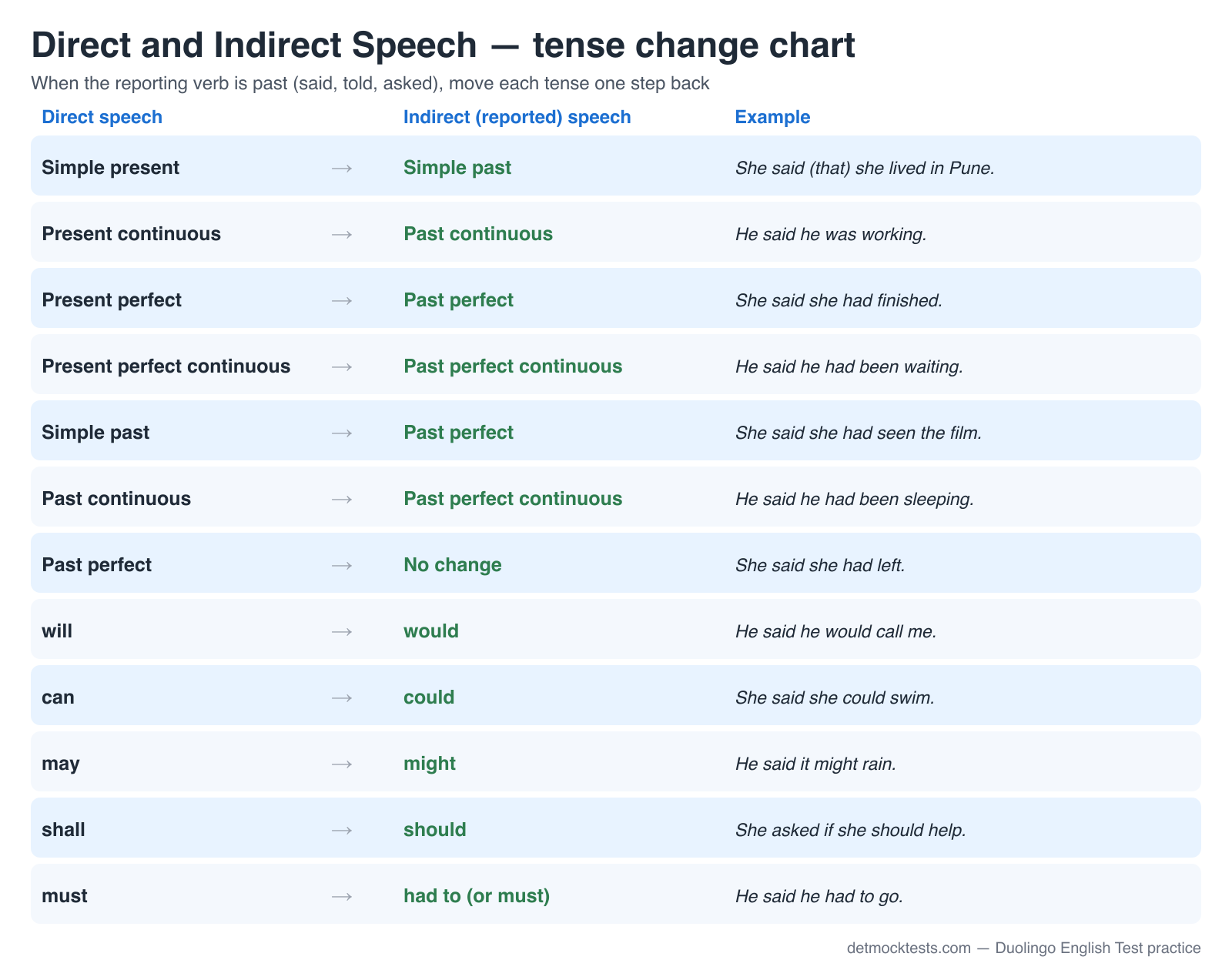
| Direct speech | Indirect speech | Direct example | Reported example |
|---|---|---|---|
| Simple present | Simple past | “I live in Pune.” | She said (that) she lived in Pune. |
| Present continuous | Past continuous | “I am working.” | He said he was working. |
| Present perfect | Past perfect | “I have finished.” | She said she had finished. |
| Present perfect continuous | Past perfect continuous | “I have been waiting.” | He said he had been waiting. |
| Simple past | Past perfect | “I saw the film.” | She said she had seen the film. |
| Past continuous | Past perfect continuous | “I was sleeping.” | He said he had been sleeping. |
| Past perfect | No change | “I had left.” | She said she had left. |
| will | would | “I will call you.” | He said he would call me. |
| can | could | “I can swim.” | She said she could swim. |
| may | might | “It may rain.” | He said it might rain. |
| shall | should | “Shall I help?” | She asked if she should help. |
| must | had to (or must) | “I must go.” | He said he had to go. |
When the tense does not change: if the reporting verb is present or future (He says, “I am busy” → He says that he is busy); if the words are a universal truth or a fact that is still true (The teacher said that water boils at 100°C); and when the verb is already past perfect.
How pronouns change: the SON rule
Pronouns change to fit who is reporting and who is listening. Indian grammar books teach this as SON:
| Person in direct speech | Changes to match | Example |
|---|---|---|
| 1st person (I, we, my, our) | The Subject of the reporting verb | Ravi said, “I am late” → Ravi said that he was late. |
| 2nd person (you, your) | The Object of the reporting verb | She said to me, “You are right” → She told me that I was right. |
| 3rd person (he, she, it, they) | No change | He said, “She is ill” → He said that she was ill. |
Time and place words in reported speech
| Direct speech | Indirect speech |
|---|---|
| now | then |
| today | that day |
| tonight | that night |
| yesterday | the day before / the previous day |
| tomorrow | the next day / the following day |
| last week | the week before / the previous week |
| next week | the following week |
| ago | before |
| this | that |
| these | those |
| here | there |
Some verbs move with them: come often becomes go when the place changes (“Come here” → told me to go there).
Questions, commands, exclamations and suggestions
| Sentence type | Rule | Example |
|---|---|---|
| Statement | said / told + that | She said, “I like it.” → She said that she liked it. |
| Yes/no question | asked + if / whether + statement order | “Are you ready?” he said. → He asked if I was ready. |
| Wh- question | asked + wh-word + statement order | “Why are you late?” → She asked why I was late. |
| Command | told / ordered + person + to + verb | “Sit down,” said the teacher. → The teacher told us to sit down. |
| Negative command | told + person + not to + verb | “Don’t touch it.” → He told me not to touch it. |
| Request | requested + person + to + verb | “Please help me.” → She requested me to help her. |
| Exclamation | exclaimed with joy / sorrow + that | “Hurrah! We won!” → They exclaimed with joy that they had won. |
| Suggestion (let’s) | suggested that + subject + should | “Let’s eat out.” → He suggested that they should eat out. |
Direct and indirect speech examples
| Direct speech | Indirect speech |
|---|---|
| He said, “I am hungry.” | He said that he was hungry. |
| She said to me, “I will help you.” | She told me that she would help me. |
| Ravi said, “I have lost my keys.” | Ravi said that he had lost his keys. |
| They said, “We are going to the market.” | They said that they were going to the market. |
| Anu said, “I met him yesterday.” | Anu said that she had met him the day before. |
| The teacher said, “The earth moves round the sun.” | The teacher said that the earth moves round the sun. (A universal truth keeps its tense.) |
| He says, “I like tea.” | He says that he likes tea. (Present reporting verb: no backshift.) |
| She said to him, “Are you coming?” | She asked him if he was coming. |
| He said to me, “Where do you live?” | He asked me where I lived. |
| The doctor said to the patient, “Take this medicine twice a day.” | The doctor advised the patient to take that medicine twice a day. |
| Mother said, “Don’t make a noise.” | Mother told us not to make a noise. |
| He said to her, “Please lend me your pen.” | He requested her to lend him her pen. |
| She said, “What a beautiful garden!” | She exclaimed that it was a very beautiful garden. |
| He said, “Let’s go for a walk.” | He suggested that they should go for a walk. |
| Mira said, “I can’t come here tomorrow.” | Mira said that she couldn’t go there the next day. |
| The boy said, “I was playing when it started to rain.” | The boy said that he had been playing when it started to rain. |
Common mistakes in reported speech
| Wrong | Right | Why |
|---|---|---|
| He asked me where | He asked me where I lived. | Reported questions use statement word order. |
| She | She told me that she was busy. | Said takes no person; told does. |
| He told that he | He said that he was tired. | Past reporting verb: shift the tense back. |
| She asked | She asked if I was free. | No that before a reported question. |
| He told me | He told me not to go. | Negative commands become not to + verb. |
Backshift is tense work: if had gone or had been waiting feels unsure, revise the English tenses chart first.
How this shows up on the Duolingo English Test
No DET task asks you to “change the narration”, but reporting what someone said is exactly what one task asks for, and the grammar shows up across the test:
| DET task | How reported speech helps |
|---|---|
| Interactive Listening | The task ends with a written summary of the conversation, which is reported speech: “The student asked whether…, and the tutor said that…”. See how to write a summary. |
| Listen and Type | Backshifted forms (had been, would have) are easy to mishear; knowing the pattern helps you type the full verb. |
| Writing Sample & Speaking tasks | Reporting an opinion or an experience (“My teacher told me that…”) shows range; “asked me where did I live” costs accuracy. |
Put it under exam conditions with a full Duolingo English Test mock, or drill single question types from the question-type guides.
Change the verb into reported speech
The reporting verb is past (said). Choose the correct form of the bold verb in reported speech.
Direct and indirect speech exercises, with answers
Twelve exercises: statements, questions, commands, exclamations, suggestions, a universal truth, one indirect-to-direct and one error correction.
- Change into indirect speech: She said, “I am busy today.”
- Change into indirect speech: He said to me, “I will meet you tomorrow.”
- Change into indirect speech: Ravi said, “I have passed the exam.”
- Change into indirect speech: She said to him, “Do you like coffee?”
- Change into indirect speech: The man said to me, “Where is the station?”
- Change into indirect speech: The teacher said, “Open your books.”
- Change into indirect speech: He said to her, “Don’t be late.”
- Change into indirect speech: She said, “Alas! I have lost my purse.”
- Change into indirect speech: He said, “Let’s start now.”
- Change into indirect speech: Father said, “Honesty is the best policy.”
- Change into direct speech: She told me that she was leaving the next day.
- Correct the error: He asked me where did I live.
Show the answer key
- She said that she was busy that day.
- He told me that he would meet me the next day.
- Ravi said that he had passed the exam.
- She asked him if (whether) he liked coffee.
- The man asked me where the station was.
- The teacher told (ordered) us to open our books.
- He told her not to be late.
- She exclaimed with sorrow that she had lost her purse.
- He suggested that they should start then.
- Father said that honesty is the best policy. (A universal truth keeps its tense.)
- She said to me, “I am leaving tomorrow.”
- He asked me where I lived. (Reported questions use statement word order.)
Direct and indirect speech: quick reference
| Question | Answer |
|---|---|
| Direct speech | Exact words in quotation marks: She said, “I am tired.” |
| Indirect (reported) speech | The meaning in your own sentence: She said that she was tired. |
| Narration | The Indian-school name for changing direct speech into indirect speech. |
| Backshift | After a past reporting verb: present → past, past → past perfect, will → would, can → could. |
| No backshift | Present or future reporting verb, universal truths, past perfect. |
| Pronouns (SON) | 1st person → subject of the reporting verb; 2nd person → object; 3rd person → no change. |
| Time and place | now → then, today → that day, tomorrow → the next day, here → there. |
| Questions | asked + if/whether or the wh-word + statement word order; no question mark. |
| Commands | told / ordered / requested + person + to (not to) + verb. |
| Exclamations | exclaimed with joy / sorrow + that + statement. |
Direct and indirect speech: your questions
What is direct and indirect speech?
Direct speech repeats someone’s exact words inside quotation marks: She said, “I am tired.” Indirect speech, also called reported speech, gives the meaning in your own sentence without quotation marks, usually with changes to tense, pronouns and time words: She said that she was tired.
What is narration in English grammar?
In Indian school grammar, narration is the topic of reporting what someone said, which means changing direct speech into indirect speech and back. “Change the narration” is the same exercise as “change into indirect (reported) speech”. Outside grammar, narration also means telling a story.
What are the rules of direct and indirect speech?
Change the reporting verb where needed (said to → told / asked); remove the quotation marks and add a linking word (that, if, whether, or the question word); shift the tense one step back if the reporting verb is past; change pronouns to fit the new speaker; and change words of time and place (now → then, here → there).
When does the tense not change in reported speech?
When the reporting verb is in the present or future (He says, “I like tea” → He says that he likes tea); when the reported words are a universal truth, a scientific fact or a habitual fact (The earth moves round the sun); and when the direct speech is already past perfect. In speech, the tense is also often kept when the fact is still true now.
How do pronouns change in indirect speech?
Change them to fit who is now speaking and listening. Many Indian grammar books teach this as the SON rule: first-person pronouns change to match the Subject of the reporting verb, second-person pronouns change to match the Object, and third-person pronouns make No change. So He said to me, “You are late” becomes He told me that I was late.
How do time and place words change in reported speech?
Words that point to the moment or place of speaking move away from it: now → then, today → that day, tomorrow → the next day, yesterday → the day before, last week → the week before, ago → before, here → there, this → that, these → those. If you report on the same day and in the same place, you can keep them.
How do you change a question into indirect speech?
Use asked (or enquired), drop the question mark and use statement word order. For yes/no questions add if or whether: “Are you ready?” → He asked if I was ready. For wh- questions keep the question word: “Where do you live?” → She asked where I lived, not “where did I live”.
How do you change an imperative sentence into indirect speech?
Use a verb that shows the kind of command — told, ordered, advised, requested, begged — followed by the listener and to + the verb: “Sit down,” said the teacher → The teacher told us to sit down. For negatives use not to: “Don’t shout” → He told them not to shout. Please becomes requested.
How do you change an exclamatory sentence into indirect speech?
Use exclaimed with a phrase that shows the feeling (with joy, with sorrow, with surprise) and turn the exclamation into a statement: “What a lovely view!” → She exclaimed that it was a very lovely view. “Alas! I failed” → He exclaimed with sorrow that he had failed. Interjections such as alas and hurrah are dropped.
What is the difference between said and told in reported speech?
Told needs a person after it; said does not. So: She told me that she was busy, or She said that she was busy, but not “She said me”. If the direct speech has said to + person, it usually becomes told + person in indirect speech.
Is “that” necessary in indirect speech?
No. In everyday English that is often left out after said and told: He said (that) he was tired. School exams usually expect it to be written, so include it in exercises. Do not use that before a reported question: “He asked that where I lived” is wrong.
How does “must” change in reported speech?
When must means obligation it usually becomes had to: “I must go” → He said he had to go. When it expresses a deduction, a rule that is still in force, or advice, must can stay: “You must be tired” → She said I must be tired. Both are accepted in exams if the meaning is kept.
How do you change “Let’s” into indirect speech?
When let’s makes a suggestion, use suggested or proposed + that + subject + should: “Let’s go out,” he said → He suggested that they should go out. When let asks for permission (“Let me go”), use requested or asked: He requested that he might be allowed to go.
What are some direct and indirect speech examples?
He said, “I am hungry” → He said that he was hungry. She said to me, “Are you free?” → She asked me if I was free. The teacher said, “Be quiet” → The teacher told us to be quiet. Ravi said, “I met her yesterday” → Ravi said that he had met her the day before. The examples table on this page has more.
How do you change indirect speech back into direct speech?
Reverse the steps: use said or said to and put the words inside quotation marks; change the tense one step forward (was → is, had gone → went); change pronouns back to the speaker’s point of view; and restore time and place words (the next day → tomorrow). Restore the question mark or exclamation mark if the original was a question or exclamation.
Why does reported speech matter for the Duolingo English Test?
Because summarising what someone said is reported speech. At the end of Interactive Listening you write a summary of a conversation, and it reads naturally only in reported form: “The student asked for an extension, and the tutor agreed to give her until Wednesday.” Correct backshift and pronouns also count towards grammar accuracy in Writing and Speaking.
Start a practice test
An hour under real conditions, all eight subscores, and feedback on every written and spoken answer.
Take a test