Figures of speech
What a figure of speech is, the eight you meet most, a list of 25 with examples, a chart to save, and exercises to check you can tell a simile from a metaphor.
- 25 figures of speech, each with a definition and an example
- A figures of speech chart to save or print
- 50 example sentences, a quiz and a worksheet with answers
When someone says “I have told you a million times”, nobody counts. English is full of sentences like this, where the words are not meant literally, and each pattern has a name. This page explains what a figure of speech is, gives the types of figures of speech with a definition and an example for each, shows how to identify one in a sentence, and ends with a quiz and a worksheet.
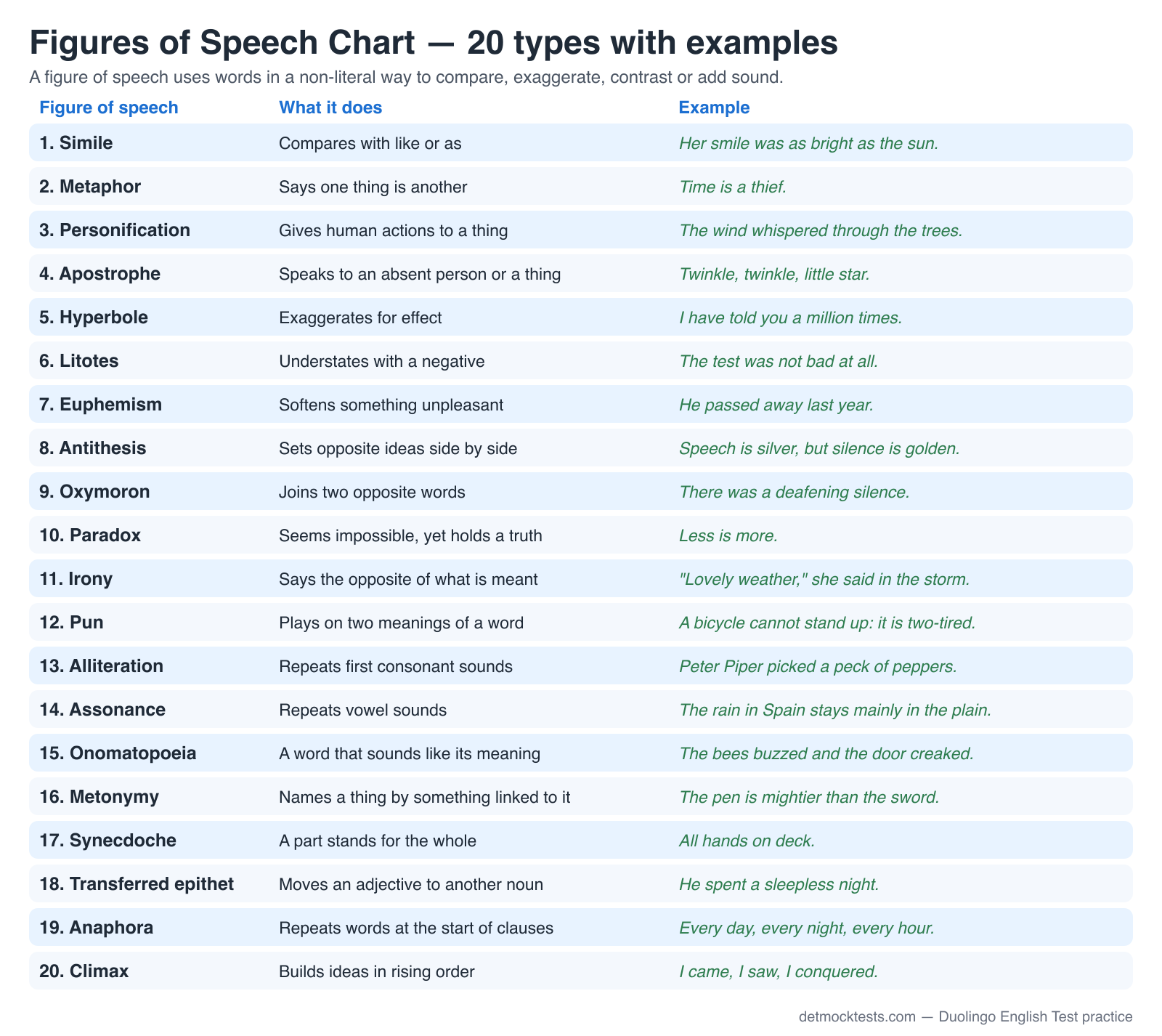
Figures of speech chart
Twenty figures of speech on one page: what each does, and a one-line example.
What is a figure of speech?
A figure of speech is a deliberate move away from the plain, literal meaning of words in order to create an effect. The literal sentence gives information. The figurative one gives the same information and a picture, a feeling or a sound with it.
| Literal | Figurative | Figure of speech |
|---|---|---|
| He is very brave. | He is as brave as a lion. | Simile |
| The room was hot and tense. | The room was a pressure cooker. | Metaphor |
| I have told you many times. | I have told you a million times. | Hyperbole |
| The leaves moved in the wind. | The leaves danced in the wind. | Personification |
| It was very quiet. | There was a deafening silence. | Oxymoron |
Figures of speech are not only for poems. You hear them in conversation (“I’m starving”), in news headlines (“Downing Street said…”) and in every advert.
The 8 main figures of speech
If a textbook, a teacher or an exam asks for “the figures of speech”, these eight are almost always on the list.
Simile
A comparison that uses like or as: “He runs like the wind.”
Metaphor
A direct comparison with no like or as: “The city is a jungle.”
Personification
A thing acts like a person: “Opportunity knocked on her door.”
Hyperbole
Exaggeration nobody takes literally: “I could eat a horse.”
Alliteration
Repeated opening consonants: “Wild winds whipped the waves.”
Onomatopoeia
A word that sounds like its meaning: “The door creaked, then banged.”
Oxymoron
Two opposite words together: “a deafening silence”.
Irony
The opposite of what is said or expected: “A traffic officer got a parking ticket.”
25 types of figures of speech, with examples
The same figures, and the less common ones, grouped by what they do. The grouping is the fastest way to remember them: first decide the family, then the exact name.
Comparison: figures that compare one thing with another
| # | Figure of speech | What it is | Example |
|---|---|---|---|
| 1 | Simile | Compares two unlike things using like or as. | The classroom was as quiet as a library at midnight. |
| 2 | Metaphor | Says one thing is another, with no like or as. | The exam hall was a pressure cooker. |
| 3 | Personification | Gives human actions or feelings to an object, animal or idea. | The alarm clock screamed at me. |
| 4 | Apostrophe | Speaks directly to someone absent, to a thing or to an idea. | Twinkle, twinkle, little star, how I wonder what you are. |
Exaggeration and softening: figures that say more, or less, than is literally true
| # | Figure of speech | What it is | Example |
|---|---|---|---|
| 5 | Hyperbole | Deliberate exaggeration for emphasis or humour. | This bag weighs a ton. |
| 6 | Litotes | Understatement that states a positive by denying its opposite. | She is no fool. (= she is clever) |
| 7 | Euphemism | A mild word used in place of a harsh or unpleasant one. | The company is letting some staff go. |
Contrast: figures built on opposites
| # | Figure of speech | What it is | Example |
|---|---|---|---|
| 8 | Antithesis | Two opposite ideas placed in a balanced sentence. | To err is human; to forgive, divine. |
| 9 | Oxymoron | Two opposite words placed next to each other. | It was a bittersweet goodbye. |
| 10 | Paradox | A statement that seems to contradict itself but holds a truth. | The more you learn, the more you realise how little you know. |
| 11 | Irony | Words that mean the opposite of what they say, or an outcome opposite to what is expected. | The fire station burned down. |
| 12 | Epigram | A short, witty saying, often with a twist. | The child is father of the man. |
Sound: figures that work on the ear
| # | Figure of speech | What it is | Example |
|---|---|---|---|
| 13 | Alliteration | The same consonant sound at the start of nearby words. | She sells seashells by the seashore. |
| 14 | Assonance | The same vowel sound repeated in nearby words. | The rain in Spain stays mainly in the plain. |
| 15 | Consonance | The same consonant sound repeated inside or at the end of words. | The lumpy, bumpy road made us jump. |
| 16 | Onomatopoeia | A word that imitates the sound it names. | The bacon sizzled in the pan. |
Association: figures that name one thing by another connected to it
| # | Figure of speech | What it is | Example |
|---|---|---|---|
| 17 | Metonymy | Names something by a thing closely linked to it. | The pen is mightier than the sword. (writing, war) |
| 18 | Synecdoche | A part stands for the whole, or the whole for a part. | All hands on deck. (hands = sailors) |
| 19 | Transferred epithet | An adjective is moved from the person it describes to a nearby noun. | She lay awake through a sleepless night. (she was sleepless, not the night) |
| 20 | Allusion | A brief reference to a well-known person, story or event. | He was a real Romeo with the ladies. |
Arrangement and wordplay: figures made by ordering or playing with words
| # | Figure of speech | What it is | Example |
|---|---|---|---|
| 21 | Anaphora | The same word or phrase repeated at the start of clauses. | Every day we work, every day we learn, every day we improve. |
| 22 | Climax | Ideas arranged in rising order of importance. | I came, I saw, I conquered. |
| 23 | Anticlimax | A sudden drop from the serious to the trivial. | He lost his family, his home and his umbrella. |
| 24 | Rhetorical question | A question asked for effect, not for an answer (in older grammars, interrogation). | Who does not want to be happy? |
| 25 | Pun | A play on two meanings of a word, or on words that sound alike. | Time flies like an arrow; fruit flies like a banana. |
Simile and metaphor: the difference
Both compare two unlike things. The only difference is the comparing word.
| Simile | Metaphor | |
|---|---|---|
| How it compares | Says A is like B | Says A is B |
| Signal words | like, as, as … as | None |
| Example 1 | Life is like a journey. | Life is a journey. |
| Example 2 | He fought like a lion. | He was a lion in the fight. |
| Example 3 | I slept like a baby. | I was a log last night. |
| Effect | Softer: it points out a likeness | Stronger: it makes the two things one |
Figures of speech that are easy to mix up
| Pair | How to tell them apart |
|---|---|
| Simile / metaphor | Like or as is present in a simile, absent in a metaphor. |
| Metaphor / personification | Personification is a metaphor in which the comparison is always to a person: “the sun smiled”. |
| Oxymoron / paradox | An oxymoron is two words (“living dead”); a paradox is a whole statement (“less is more”). |
| Antithesis / oxymoron | Antithesis balances two opposite ideas across a sentence; an oxymoron puts two opposite words together. |
| Metonymy / synecdoche | Metonymy uses something linked (“the Crown”); synecdoche uses an actual part (“hands” for workers). |
| Alliteration / assonance | Alliteration repeats first consonants; assonance repeats vowel sounds. |
| Hyperbole / litotes | Hyperbole says too much (“starving”); litotes says too little (“not bad”). |
| Irony / sarcasm | Sarcasm is irony used to mock a person. Irony can also be a situation, with no speaker at all. |
| Personification / apostrophe | Personification describes a thing as human; apostrophe talks to it: “O wind, be still.” |
How to identify the figure of speech in a sentence
Read it literally first
Could the sentence be true word for word? “The moon hid behind the clouds” could not, so a figure of speech is at work.
Look for a comparison
Two unlike things set side by side: like or as gives a simile, a direct “is” gives a metaphor, a human verb with a non-human subject gives personification.
Check the size of the claim
Far too big is hyperbole (“a ton”); deliberately too small is litotes (“not bad”); politely softened is a euphemism (“passed away”).
Look for opposites
Two opposite words together make an oxymoron, two opposite ideas in balance make antithesis, and words that mean the reverse of what they say are irony.
Listen to the sounds
Repeated first letters are alliteration, repeated vowels are assonance, and a word that makes its own noise (buzz, crash) is onomatopoeia.
Name every figure you find
One sentence can hold two. “The silence screamed” is personification and a paradox. In an exam, give the most obvious one first.
50 figures of speech examples
Cover the right-hand column and name each one before you check.
| # | Sentence | Figure of speech |
|---|---|---|
| 1 | The classroom was as quiet as a library at midnight. | Simile |
| 2 | He runs like the wind. | Simile |
| 3 | Her words cut like a knife. | Simile |
| 4 | My grandmother’s hands were as soft as cotton. | Simile |
| 5 | The exam hall was a pressure cooker. | Metaphor |
| 6 | Time is a thief. | Metaphor |
| 7 | The city is a jungle. | Metaphor |
| 8 | Laughter is the best medicine. | Metaphor |
| 9 | He has a heart of stone. | Metaphor |
| 10 | The wind whispered through the trees. | Personification |
| 11 | The alarm clock screamed at me. | Personification |
| 12 | Opportunity knocked on her door. | Personification |
| 13 | The sun smiled down on the village. | Personification |
| 14 | I have told you a million times. | Hyperbole |
| 15 | This bag weighs a ton. | Hyperbole |
| 16 | I am so hungry I could eat a horse. | Hyperbole |
| 17 | She cried a river of tears. | Hyperbole |
| 18 | Peter Piper picked a peck of pickled peppers. | Alliteration |
| 19 | She sells seashells by the seashore. | Alliteration |
| 20 | The rain in Spain stays mainly in the plain. | Assonance |
| 21 | The bees buzzed around the hive. | Onomatopoeia |
| 22 | The bacon sizzled in the pan. | Onomatopoeia |
| 23 | The door creaked, then banged shut. | Onomatopoeia |
| 24 | There was a deafening silence in the room. | Oxymoron |
| 25 | It was a bittersweet goodbye. | Oxymoron |
| 26 | The film was seriously funny. | Oxymoron |
| 27 | Please hand me the original copy. | Oxymoron |
| 28 | The fire station burned down. | Irony |
| 29 | “What lovely weather,” he said, as the rain soaked his shoes. | Irony |
| 30 | The traffic officer got a parking ticket. | Irony |
| 31 | He passed away peacefully. | Euphemism |
| 32 | The company is letting some staff go. | Euphemism |
| 33 | The test was not bad at all. | Litotes |
| 34 | She is no fool. | Litotes |
| 35 | To err is human; to forgive, divine. | Antithesis |
| 36 | Many are called, but few are chosen. | Antithesis |
| 37 | Less is more. | Paradox |
| 38 | The more you learn, the more you realise how little you know. | Paradox |
| 39 | The pen is mightier than the sword. | Metonymy |
| 40 | The whole school turned up to watch the match. | Metonymy |
| 41 | The kettle is boiling. | Metonymy |
| 42 | All hands on deck. | Synecdoche |
| 43 | He bought a new set of wheels. | Synecdoche |
| 44 | She lay awake through a sleepless night. | Transferred epithet |
| 45 | They walked home down a lonely road. | Transferred epithet |
| 46 | Twinkle, twinkle, little star, how I wonder what you are. | Apostrophe |
| 47 | I came, I saw, I conquered. | Climax |
| 48 | He lost his family, his home and his umbrella. | Anticlimax |
| 49 | Every day we work, every day we learn, every day we improve. | Anaphora |
| 50 | Time flies like an arrow; fruit flies like a banana. | Pun |
Figures of speech you already use
Most figures of speech in real English go unnoticed because they are so common.
| You say | You mean | Figure of speech |
|---|---|---|
| I’m starving. | I am very hungry. | Hyperbole |
| It’s not rocket science. | It is easy. | Litotes |
| She passed away. | She died. | Euphemism |
| The White House announced… | The US president’s office announced… | Metonymy |
| Nice wheels! | Nice car! | Synecdoche |
| My phone died. | The battery ran out. | Personification |
| He’s a night owl. | He stays up late. | Metaphor |
| Same difference. | It makes no difference. | Oxymoron |
| Oh great, another meeting. | I do not want another meeting. | Irony |
Figures of speech and poetic devices
In school poetry questions, “poetic devices” means every figure of speech above plus the tools of verse that are not figures of speech. If a question asks for the poetic devices in a stanza, look for both.
| Poetic device | What it is | Figure of speech? |
|---|---|---|
| Simile, metaphor, personification, alliteration… | Everything in the list above | Yes |
| Rhyme | Line endings that sound alike (night / light) | No |
| Rhyme scheme | The pattern of rhymes in a stanza, written abab, aabb | No |
| Imagery | Words that appeal to the senses: sight, sound, smell, taste, touch | No, but figures of speech create it |
| Repetition and refrain | A word or line repeated for emphasis; a refrain repeats at the end of stanzas | Anaphora is one kind |
| Symbolism | An object that stands for an idea (a dove for peace) | No |
| Enjambment | A sentence that runs on past the end of a line | No |
Common mistakes with figures of speech
| Mistake | Example | Fix |
|---|---|---|
| Calling every comparison a metaphor | “He is as tall as a tree” labelled a metaphor | As … as makes it a simile. |
| Mixing two metaphors | “We must iron out the bottlenecks.” | Keep one picture: “We must clear the bottlenecks.” |
| Using literally with a hyperbole | “I literally died laughing.” | Drop literally, or say what really happened. |
| Calling bad luck irony | “It rained on my day off. How ironic.” | Irony needs the opposite of what was expected: “It rained on the weather forecaster’s outdoor wedding.” |
| Counting letters, not sounds | “A city cat” labelled alliteration | The sounds differ (/s/ and /k/), so it is not alliteration. “A kind cat” is. |
| Worn-out phrases in formal writing | “At the end of the day, every coin has two sides.” | Say it plainly, or make a fresh comparison of your own. |
Fixed figurative phrases such as “break the ice” are idioms, which you learn whole: see the idioms and phrases list. For single words that sharpen a description, try synonyms and antonyms.
How this shows up on the Duolingo English Test
No DET task asks you to name a figure of speech. What the test rewards is understanding the non-literal meaning when you read or hear it, and describing things precisely when you speak or write:
| DET task | How figurative language helps |
|---|---|
| Interactive Reading | Passages use metaphor and personification (“a wave of applications”, “the market recovered”). Questions about the main idea need the meaning behind the picture. |
| Interactive Listening | Speakers use irony, understatement and euphemism (“not ideal”, “a bit of a problem”). Choosing the right reply depends on what they really mean. |
| Speak About the Photo & Write About the Photo | A simile is the quickest way to interpret a picture: “the street looks like a river after the rain”, “they seem as if they are waiting”. |
| Writing Sample & Speaking Sample | One fresh comparison or a rhetorical question shows range. Clichés and heavy exaggeration (“since the dawn of time”) weaken the argument. |
Put it under exam conditions with a full Duolingo English Test mock, or drill single question types from the question-type guides.
Identify the figure of speech
Read the sentence and choose the figure of speech in bold.
Figures of speech worksheet, with answers
Twelve exercises: identify the figure of speech, change a simile into a metaphor and back, and rewrite a figurative sentence literally.
- Identify the figure of speech: The moon hid behind the clouds.
- Identify the figure of speech: He is as stubborn as a mule.
- Identify the figure of speech: The classroom was a zoo.
- Identify the figure of speech: I have a thousand things to do today.
- Identify the figure of speech: The Crown will decide.
- Identify the figure of speech: It was an awfully good meal.
- Identify the figure of speech: Big blue bubbles bounced by.
- Change the simile into a metaphor: Life is like a journey.
- Change the metaphor into a simile: Her eyes were diamonds.
- Rewrite in literal English: I am drowning in emails.
- Which sentence is literal? (a) The sea was angry. (b) The sea was rough. (c) The sea swallowed the boat.
- Name the two figures of speech: The silence screamed in his ears.
Show the answer key
- Personification (the moon cannot hide)
- Simile (as … as)
- Metaphor (no like or as)
- Hyperbole
- Metonymy (the Crown = the king or queen)
- Oxymoron (awfully + good)
- Alliteration
- Life is a journey.
- Her eyes shone like diamonds. / Her eyes were as bright as diamonds.
- I have far too many emails to deal with.
- (b). The others are personification.
- Personification (silence screams) and paradox (a silent scream)
Figures of speech: quick reference
| Question | Answer |
|---|---|
| What is a figure of speech? | A word or phrase used non-literally to create an effect. |
| The main eight | Simile, metaphor, personification, hyperbole, alliteration, onomatopoeia, oxymoron, irony. |
| Simile | A comparison with like or as: as brave as a lion. |
| Metaphor | One thing is another: time is a thief. |
| Personification | A thing acts like a person: the wind whispered. |
| Hyperbole and litotes | Exaggeration (a million times) and its opposite, understatement (not bad). |
| Oxymoron and paradox | Two opposite words (deafening silence); a self-contradicting truth (less is more). |
| Metonymy and synecdoche | A linked thing (the Crown); a part for the whole (all hands on deck). |
| Sound figures | Alliteration (first consonants), assonance (vowels), consonance (inner or final consonants), onomatopoeia (sound words). |
| How to identify one | Compared? Exaggerated? Opposites? Sound? Then check for like or as. |
| In test writing | One fresh comparison helps; clichés and heavy exaggeration do not. |
Figures of speech: your questions
What is a figure of speech?
A figure of speech is a word or phrase used in a way that differs from its literal meaning, to create an effect. It may compare (“as brave as a lion”), exaggerate (“a million times”), contrast (“deafening silence”) or play with sound (“Peter Piper picked…”). Writers use figures of speech to make language vivid, memorable and persuasive.
What are the 8 main figures of speech?
The eight most commonly taught figures of speech are simile, metaphor, personification, hyperbole, alliteration, onomatopoeia, oxymoron and irony. The first four compare or exaggerate; alliteration and onomatopoeia work through sound; oxymoron and irony work through contrast. Some textbooks swap in pun, euphemism or idiom, so lists of eight are not identical everywhere.
How many figures of speech are there in English?
There is no fixed number. Classical rhetoric names more than 200 devices, but school grammars usually teach between 8 and 25. Older Indian grammars list about 19, including apostrophe, antithesis, epigram and transferred epithet. This page covers 25, which is every figure a school, college or competitive exam is likely to ask for.
What are 20 figures of speech with examples?
Twenty common ones are simile, metaphor, personification, apostrophe, hyperbole, litotes, euphemism, antithesis, oxymoron, paradox, irony, pun, alliteration, assonance, onomatopoeia, metonymy, synecdoche, transferred epithet, anaphora and climax. Each has a one-line example in the chart at the top of this page, for instance “Time is a thief” for metaphor and “All hands on deck” for synecdoche.
What is the difference between a simile and a metaphor?
Both compare two unlike things. A simile says one thing is like another, using like or as: “Her eyes shone like diamonds.” A metaphor says one thing is another, with no comparing word: “Her eyes were diamonds.” If you can find like or as doing the comparing, it is a simile.
Is “I slept like a baby” a simile or a metaphor?
It is a simile, because the comparison is made with the word like: your sleep is compared to a baby’s. The metaphor version would drop the comparing word, for example “I was a log last night.” The quick test is always the same: like or as means simile.
What is personification, with an example?
Personification gives human actions, feelings or qualities to something that is not human. “The wind whispered through the trees”, “The sun smiled on us” and “My laptop refuses to work” are all personification, because wind cannot whisper, the sun cannot smile and a laptop cannot refuse. It makes descriptions feel alive.
What is the difference between alliteration, assonance and consonance?
All three repeat sounds. Alliteration repeats the first consonant sound of nearby words (“big blue bubbles”). Assonance repeats a vowel sound anywhere in the words (“the rain in Spain”). Consonance repeats a consonant sound in the middle or at the end (“lumpy, bumpy”). Listen for the sound, not the spelling.
What is the difference between an oxymoron and a paradox?
An oxymoron is two opposite words side by side: “deafening silence”, “bittersweet”, “open secret”. A paradox is a whole statement that seems to contradict itself but turns out to be true: “Less is more”, “You have to spend money to save money”. An oxymoron is a phrase; a paradox is an idea.
What is the difference between metonymy and synecdoche?
Metonymy names something by a thing connected to it: “the Crown” for the monarch, “the kettle is boiling” for the water. Synecdoche names something by one of its parts, or a part by the whole: “all hands on deck” for sailors, “a new set of wheels” for a car. If it is a physical part, it is synecdoche.
Is sarcasm the same as irony?
Not quite. Verbal irony is saying the opposite of what you mean: “Lovely weather!” in a storm. Sarcasm is verbal irony used to mock or hurt someone: “Oh, brilliant idea.” Irony also has two types that sarcasm does not cover: situational irony (a fire station burning down) and dramatic irony (the audience knows what a character does not).
What is a transferred epithet?
A transferred epithet moves an adjective from the person it really describes to a nearby noun. In “a sleepless night”, the person is sleepless, not the night. Other examples are “a careless mistake”, “a happy morning” and “an anxious wait”. Indian school and competitive exams ask for it often, and it is also called hypallage.
Are idioms figures of speech?
Yes, in the broad sense: an idiom is a fixed phrase whose meaning is not literal, such as “break the ice”. The difference is that an idiom is a ready-made expression you learn whole, while a simile or a metaphor can be invented fresh. Our idioms and phrases list gives 72 of them with meanings and examples.
What is the difference between figures of speech, figurative language and poetic devices?
Figurative language is any non-literal use of words; a figure of speech is one named type of it, such as a simile. Poetic devices and literary devices are wider groups: they include every figure of speech plus tools that are not figures at all, such as rhyme, rhythm, imagery, symbolism and refrain.
How do I identify the figure of speech in a sentence?
Ask four questions in order. Is something being compared (simile, metaphor, personification)? Is something exaggerated or played down (hyperbole, litotes, euphemism)? Are opposites involved (oxymoron, antithesis, paradox, irony)? Is a sound repeated or imitated (alliteration, assonance, onomatopoeia)? Then check the detail: like or as means simile, a human verb with a non-human subject means personification.
Why do writers use figures of speech?
Because a picture is quicker than an explanation. “The exam hall was a pressure cooker” gives the heat, the tension and the feeling of being trapped in six words. Figures of speech add emphasis, emotion, humour and rhythm, and they make a sentence easier to remember, which is why poems, speeches, adverts and headlines are full of them.
Should I use figures of speech in an essay or an English test?
Use them lightly. One fresh comparison or a rhetorical question can lift an essay, but worn-out phrases (“since the dawn of time”, “at the end of the day”) and heavy exaggeration weaken an argument. In formal and test writing, clear literal sentences should carry the points, with a figure of speech only where it adds meaning.
Do figures of speech come up on the Duolingo English Test?
No question asks you to name one, but you meet them constantly. Reading passages use metaphors and personification, conversations in Interactive Listening use irony, understatement and euphemism, and a well-chosen simile makes a photo description more precise. Understanding the non-literal meaning is what the test rewards; the label is not needed.
Start a practice test
An hour under real conditions, all eight subscores, and feedback on every written and spoken answer.
Take a test