Two students who know the same amount rarely get the same mark. One runs out of time, misreads a question or leaves blanks; the other does not. The difference is technique, and technique can be learned in a week. These tips work for school and university exams, competitive exams and English proficiency tests. Where a tip does not apply to a computer test such as the Duolingo English Test, it says so.
What are test-taking strategies?
Test-taking strategies are methods for preparing for an exam and for working through it, so that your mark shows what you really know. They do not replace study. They stop you losing marks you had already earned: to the clock, to a misread question, to a blank, or to nerves.
| Stage | What the strategies protect you from | Tips |
|---|---|---|
| Before the exam | Studying the wrong things, or in a way that does not stick | 1–10 |
| Exam day | Arriving tired, late or flustered | 11–16 |
| During the exam | Running out of time, misreading, leaving blanks | 17–26 |
| After the exam | Making the same mistakes next time | 27–30 |
Before the exam: 10 preparation tips
| # | Tip | How to do it |
|---|---|---|
| 1 | Find out exactly how the exam works | Sections, timing, marks for each question, whether wrong answers lose marks, and whether you can go back. Every later decision depends on this. |
| 2 | Start early and spread it out | Six half-hours over six days beat three hours in one evening. Coming back to a topic after a gap is what makes it stick. |
| 3 | Test yourself; do not reread | Close the book and write or say what you remember, then check. Use flashcards and past questions. Recalling is the practice the exam itself demands. |
| 4 | Sit past papers under the real time limit | Do a whole past paper or mock test at least twice, timed, in one sitting each time. It shows you where the time goes before it matters. |
| 5 | Work on your weakest area first | Marks are cheapest where you are weakest: going from 40% to 60% is easier than from 85% to 95%. |
| 6 | Mix topics in one session | The exam will not group its questions by chapter, so practise switching between kinds of question. |
| 7 | Make a one-page summary for each subject | Formulas, dates, key terms, common mistakes. Writing it is revision; reading it is your last look on the day. |
| 8 | Explain it out loud | Teach a topic to a friend, or to an empty room, without notes. The point where you get stuck is what to study next. |
| 9 | Keep an error log | For every question you get wrong in practice, write the cause: did not know, misread, careless, or out of time. Review it before each paper. |
| 10 | Protect your sleep in the last week | Memory is fixed during sleep. An all-night session costs more marks in slow thinking than it gains in facts. |
Exam day: 6 tips
| # | Tip | How to do it |
|---|---|---|
| 11 | Prepare everything the night before | ID, hall ticket, pens, water. For an online test: charger, updates done, a quiet room, a tested internet connection. |
| 12 | Eat and drink something familiar | A normal breakfast and some water. Exam day is not the day to try a new energy drink. |
| 13 | Arrive or log in 30 minutes early | Lateness and technical problems are the cheapest marks to lose and the easiest to prevent. |
| 14 | Learn nothing new in the last half hour | Look over your summary sheet once. New facts at this point push out ones you already had. |
| 15 | Slow your breathing before you start | In for four, out for six, five times. It takes one minute and steadies your hands and your head. |
| 16 | Read every instruction | How many questions to answer, which are compulsory, where to write. Each year students answer five questions when the paper asked for four. |
During the exam: 10 strategies
| # | Tip | How to do it |
|---|---|---|
| 17 | Skim the whole paper first | Two minutes to see what is there and choose your order. (Not possible on adaptive computer tests, which show one question at a time.) |
| 18 | Give each question its share of the time | Minutes ÷ marks. When a question’s time is up, write what you have and move on. |
| 19 | Read the question twice and find the command word | List, explain, compare and evaluate ask for different answers. Underline the command word and any limits (“two reasons”, “in 50 words”). |
| 20 | Do the questions you find easy first | They bank marks and settle your nerves. Mark the hard ones and come back. (Where the exam lets you move around.) |
| 21 | Eliminate wrong options before you choose | Crossing out two of four options turns a 25% guess into a 50% one. |
| 22 | Know the guessing rule | No penalty for wrong answers: never leave a blank. Penalty: guess only when you have ruled out at least one option. |
| 23 | Plan before you write a long answer | One minute: your main point, two or three reasons, an example for each. A planned answer is shorter and scores higher. |
| 24 | Show your working | Steps, units, a clear structure. Markers give credit for correct steps even when the final answer is wrong. |
| 25 | Check the clock at fixed points | At one third and two thirds of the time, compare where you are with where you planned to be, and adjust. |
| 26 | Keep the last five minutes for checking | Look for blanks, misread questions and slips. Change an answer when you find a real reason to. |
After the exam: 4 tips
| # | Tip | How to do it |
|---|---|---|
| 27 | Write down what you could not answer | Do it the same day, while you remember. It is the best revision list you will ever have. |
| 28 | Sort your errors into four piles | Did not know it · misread the question · ran out of time · careless slip. Each pile needs a different fix. |
| 29 | Fix the biggest pile first | Out of time: more timed papers. Misread: underline command words. Did not know: back to self-testing on that topic. |
| 30 | Rest, then plan the next one from the evidence | Decide what to change from your error piles, not from how the exam felt. |
Tips by question type
| Question type | What to do | The common mistake |
|---|---|---|
| Multiple choice | Answer in your head first, then look for it. Cross out options that are clearly wrong. | Choosing the first option that looks familiar. |
| True or false | Check every part of the statement. Words like always, never and only make a statement easier to prove false. | Reading half the sentence. |
| Fill in the blanks | Read the whole sentence, decide the part of speech, then choose the word. See our cloze test guide. | Looking only at the word before the gap. |
| Short answer | Start with the answer itself, then add one supporting fact for each mark. | Writing an introduction for a two-mark question. |
| Essay | Spend a minute on a plan: your view, two or three reasons, an example for each. See essay topics to practise with. | Starting to write before deciding what you think. |
| Reading comprehension | Find the answer in the text and point to the line. Do not answer from memory. | Choosing an option that is true in general but not stated in the passage. |
| Listening | Read the questions before the audio starts, and write as you listen. | Stopping on a word you missed while the audio moves on. |
| Speaking | Answer the question in your first sentence, then give a reason and an example. | Stopping after one sentence, or starting again after a small slip. |
Time management in exams
One sum, done before you start, solves most timing problems:
| If the exam is… | Do this |
|---|---|
| A paper you can move around in | Two passes: first the questions you can do, then the ones you marked. Check the clock at one third and two thirds of the time. |
| Sections with their own time limits | Treat each section as its own exam. Time saved in one section cannot be spent in another. |
| A computer test with a timer on each question | There is nothing to plan across the paper, so plan inside each question: decide how long you will think before you start typing or speaking. |
| Running out of time | For long answers, switch to bullet points: most marking schemes give credit for correct points however they are written. |
Exam myth or fact? A quiz
Twelve things students tell each other before exams. Decide whether each one is a fact or a myth; the reasons are in the table underneath.
Show the reasons
| Statement | Fact or myth | Why |
|---|---|---|
| “C” is the most common correct answer in multiple choice. | Myth | Good tests spread the correct answers across the positions, usually at random. |
| Your first answer is usually right, so never change it. | Myth | Studies of answer-changing find more changes from wrong to right than from right to wrong. |
| Testing yourself helps you remember more than rereading your notes. | Fact | Practice testing was rated one of the two most effective techniques in a 2013 review of study methods. |
| Studying a little each day beats one long session the night before. | Fact | Spaced practice was the other technique rated most effective in the same review. |
| Highlighting most of the page is a good way to learn it. | Myth | Highlighting was rated among the least useful techniques: it feels like work but needs no recall. |
| A full night’s sleep helps more than an extra night of study. | Fact | Memories are consolidated during sleep, and tired students think more slowly and misread more. |
| If wrong answers lose no marks, you should answer every question. | Fact | A blank scores zero for certain; a guess sometimes scores. |
| Longer answers always get more marks. | Myth | Marks are given for correct points, not for length. Padding costs time you need elsewhere. |
| On every test you can skip a hard question and come back to it. | Myth | Adaptive computer tests, such as the Duolingo English Test, show one question at a time with no going back. |
| Practising under the real time limit makes the real exam easier. | Fact | Timed practice shows where your time goes and makes the format familiar before it counts. |
| Hard questions on an adaptive test mean you are failing. | Myth | An adaptive test gives harder questions when you answer well. |
| Reading the question twice is a waste of exam time. | Myth | Ten seconds of rereading is the cheapest way to avoid losing every mark on a question you misread. |
How to write answers in an exam
For written papers, the way an answer is set out decides how easily the examiner can give you the marks.
- Answer in the first sentence. Use the words of the question: “The main cause of… was…”.
- Match the length to the marks. As a guide, one clear point for each mark. A two-mark answer is two or three lines, not a page.
- One point, one paragraph. Start each paragraph with the point, then the explanation, then an example.
- Use the subject’s own terms and underline the key ones if the paper allows it.
- Number your answers exactly as the paper does and leave a line between them.
- Keep it readable. Neat handwriting, or clean typing with full stops and capital letters, costs nothing and loses nothing.
Exam nerves
Some nervousness is normal and even useful: it keeps you alert. It becomes a problem only when it stops you thinking. Three things help in the moment:
- Slow your breathing. Breathe in for a count of four and out for a count of six, five times. Longer out-breaths slow the heart.
- Start with a question you can do. One finished answer does more for your confidence than any pep talk. On a test that does not let you choose, give the first question your full attention and nothing else.
- If your mind goes blank, move. Put the pen down, look away for ten seconds, then write anything you know about the question. Recall usually restarts once you begin.
If anxiety around exams is severe or constant, talk to a teacher, a counsellor or a doctor. It is common and there is real help for it.
Tips for English exams
English papers and English proficiency tests reward the same four skills, so the tips group the same way.
| Skill | Tips that earn marks |
|---|---|
| Reading | Read the question first so you know what to look for. Answer only from the passage. For vocabulary questions, read the sentence before and after the word. |
| Writing | Plan for a minute. Prefer a simple sentence you are sure of to a complicated one you are not. Leave two minutes to check verb endings, articles and spelling. |
| Grammar | Find the subject and the time of the sentence before choosing a verb. Revise tenses, voice and reported speech, the three areas school and competitive papers test most. |
| Listening | Read the questions before the recording. Write while you listen. If you miss a word, let it go and stay with the speaker. |
| Speaking | Answer first, then extend with a reason and an example. Keep going after a small mistake: fluency is marked too. |
Duolingo English Test tips
The Duolingo English Test is taken on a computer in about one hour, and it is adaptive: the questions get harder when you answer well. Two of the usual strategies do not apply, and one new one does.
| On a paper exam | On the Duolingo English Test |
|---|---|
| Skim the whole paper, then choose your order (tips 17 and 20) | Not possible. Questions come one at a time and you cannot skip or go back. Give each one your full attention once. |
| Budget your time across the paper (tip 18) | Each question has its own timer. The budget is inside the question: think, answer, check, before the timer ends. |
| Hard questions mean it is going badly | The opposite. On an adaptive test, harder questions mean you are doing well. |
One tip for each of the 13 question types in the current test. Each links to the full guide.
| Question type | Time | The tip |
|---|---|---|
| Read & Complete | 3 minutes | Read the whole passage before typing anything. The damaged words are recoverable from grammar and context, not from the visible letters alone — and the first sentence usually tells you the register. |
| Read & Select | 5 seconds | The invented words are built from real English morphology, so "looks plausible" is not evidence. If you have never met it, say no. Guessing yes on unfamiliar words is the most common way people lose points here. |
| Fill in the Blanks | 20 seconds | The given letters constrain the answer far more than they look like they do. Work out the meaning first, then check which word fits both the meaning and the opening letters. |
| Listen & Type | 1 minute | Type what you catch immediately, then replay to fill gaps. Starting the sentence over from scratch on each replay is how people run out of time with an empty box. |
| Speak About the Photo | 90 seconds | Describe, then interpret. Listing objects fills ten seconds; saying what is happening, who the people might be and what happens next fills ninety and shows far more language. |
| Read, Then Speak | 90 seconds | Answer every part of the prompt. Use the 20 seconds to pick one answer for each question under the topic, then cover them in order with a reason or an example each. |
| Interactive Speaking | 35 seconds each | Answer the actual question first, then add one sentence of reason or example. The next question follows your answer, so a specific reply gives you something concrete to build on. |
| Write About the Photo | 1 minute | One complex sentence beats three simple ones, but only if you finish it. An unfinished subordinate clause reads as an error. |
| Interactive Writing | 5 min + 3 min | Use the 30 seconds before the timer starts to choose your position and two reasons. In step 2, answer the follow-up in your first sentence, and build on what you already wrote rather than starting again. |
| Interactive Reading | 7 minutes | The highlight task is the one people rush. Select the exact clause that answers the question, not the whole sentence around it; over-selecting costs you. |
| Interactive Listening | 7 min 45 s | The summary is graded on whether it captures what actually happened, not on how much you write. Name the outcome and what each person agreed to. |
| Speaking Sample | 3 minutes | Institutions may watch this. Speak to a person, not to a timer — and if you finish early, stopping cleanly reads better than filling the remaining minute. |
| Writing Sample | 5 minutes | Spend the first thirty seconds deciding your two points. A response with a clear shape and a few errors scores better than a flawless one that never gets anywhere. |
Five of these are also drawn as picture cards you can save and share:
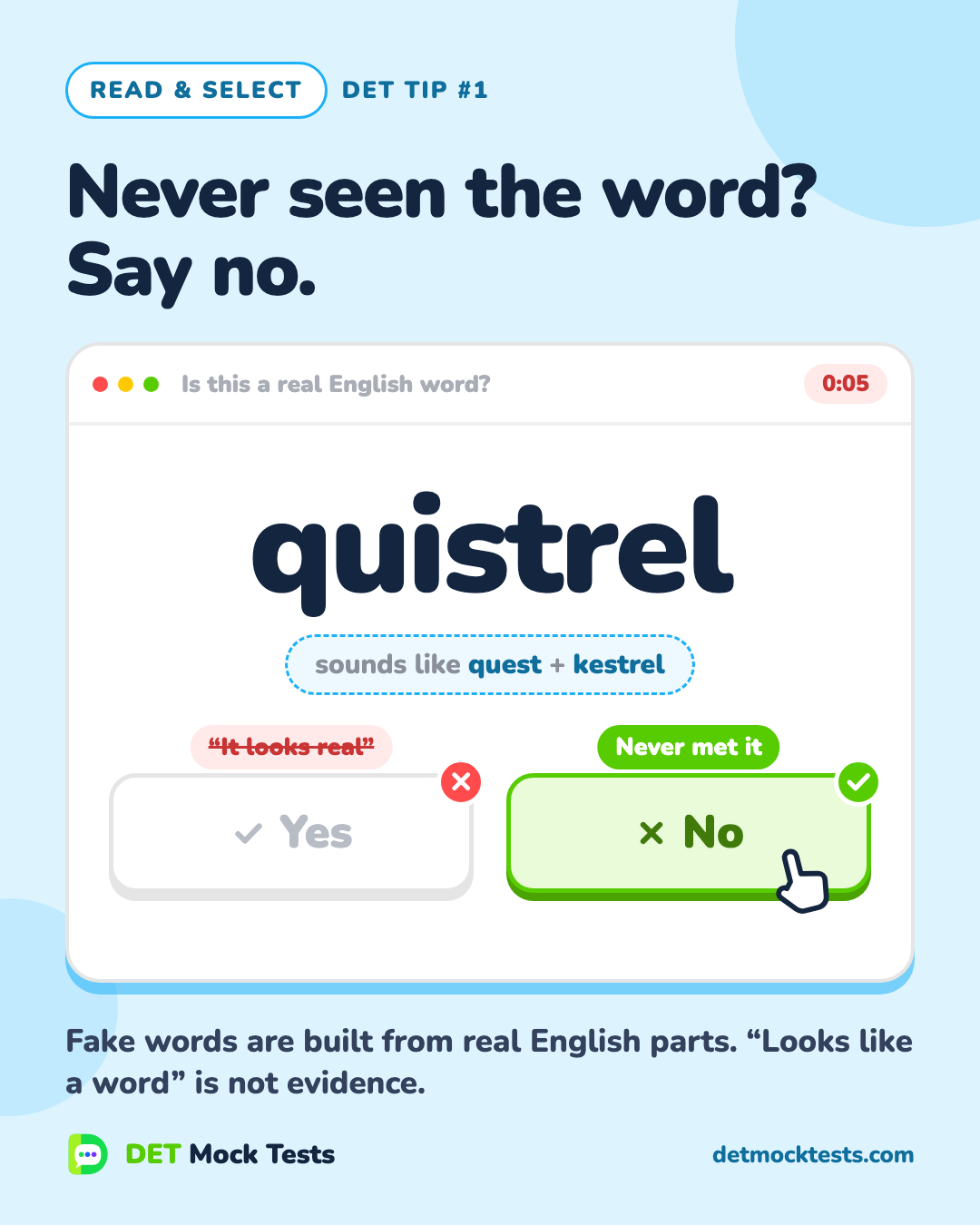
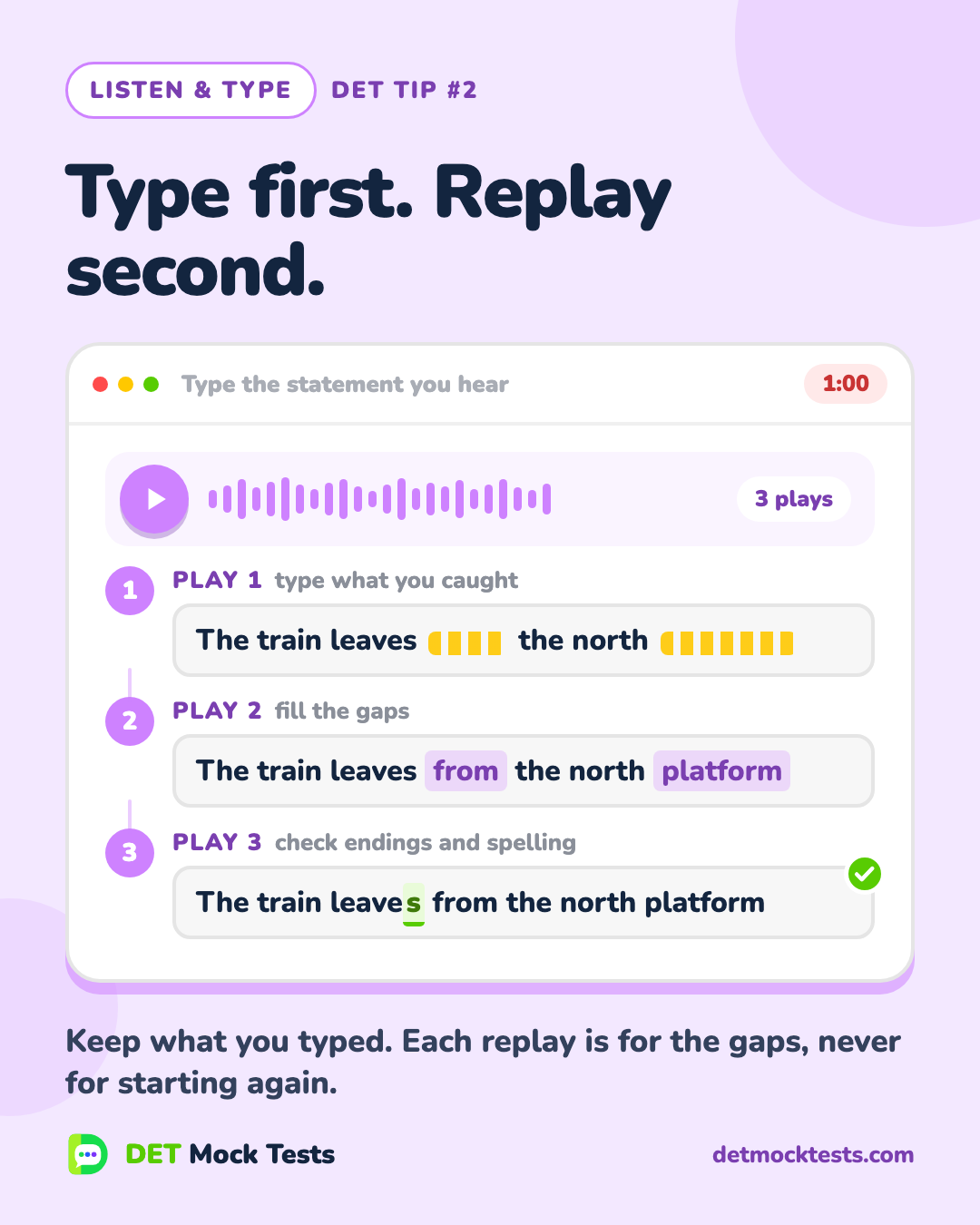
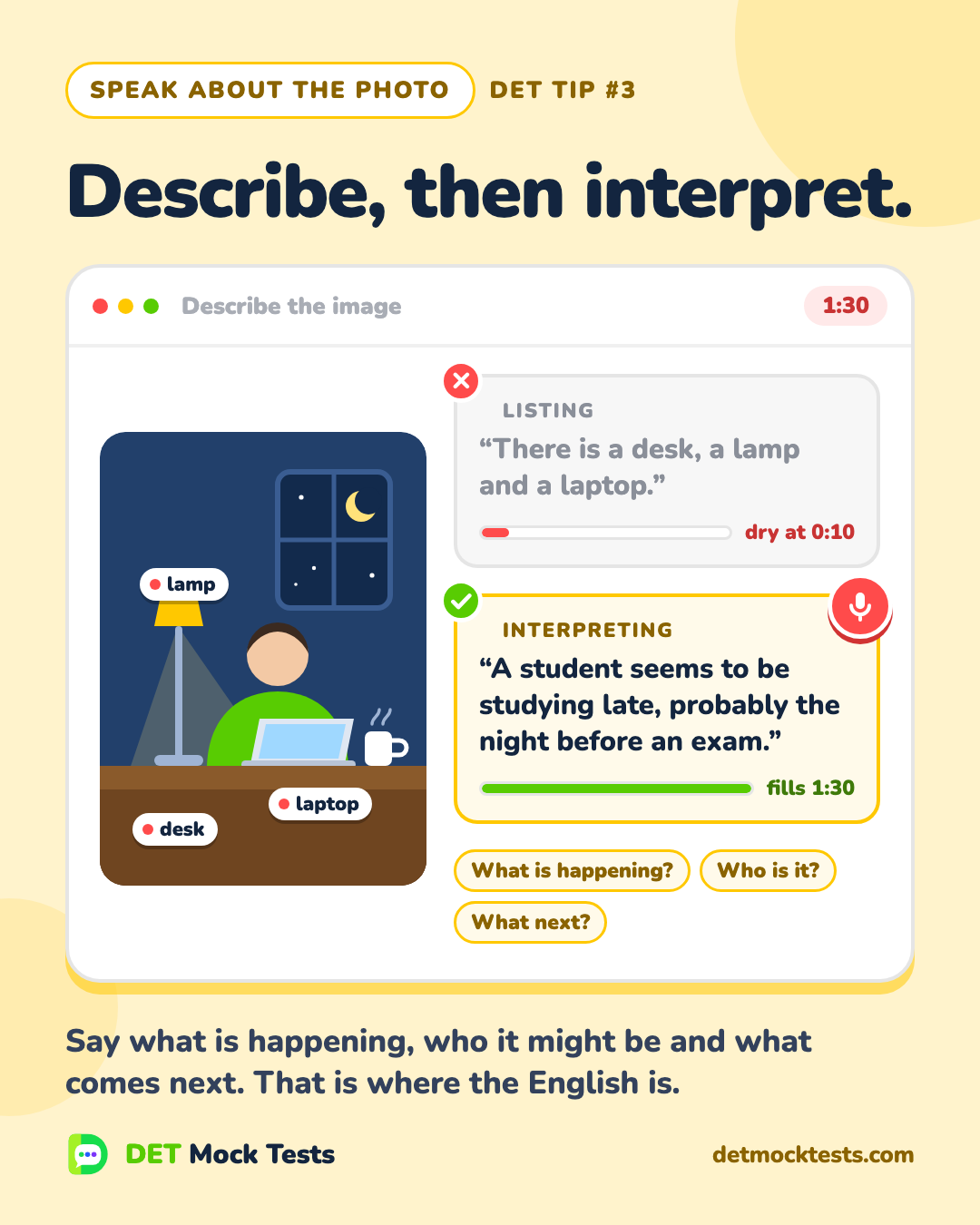
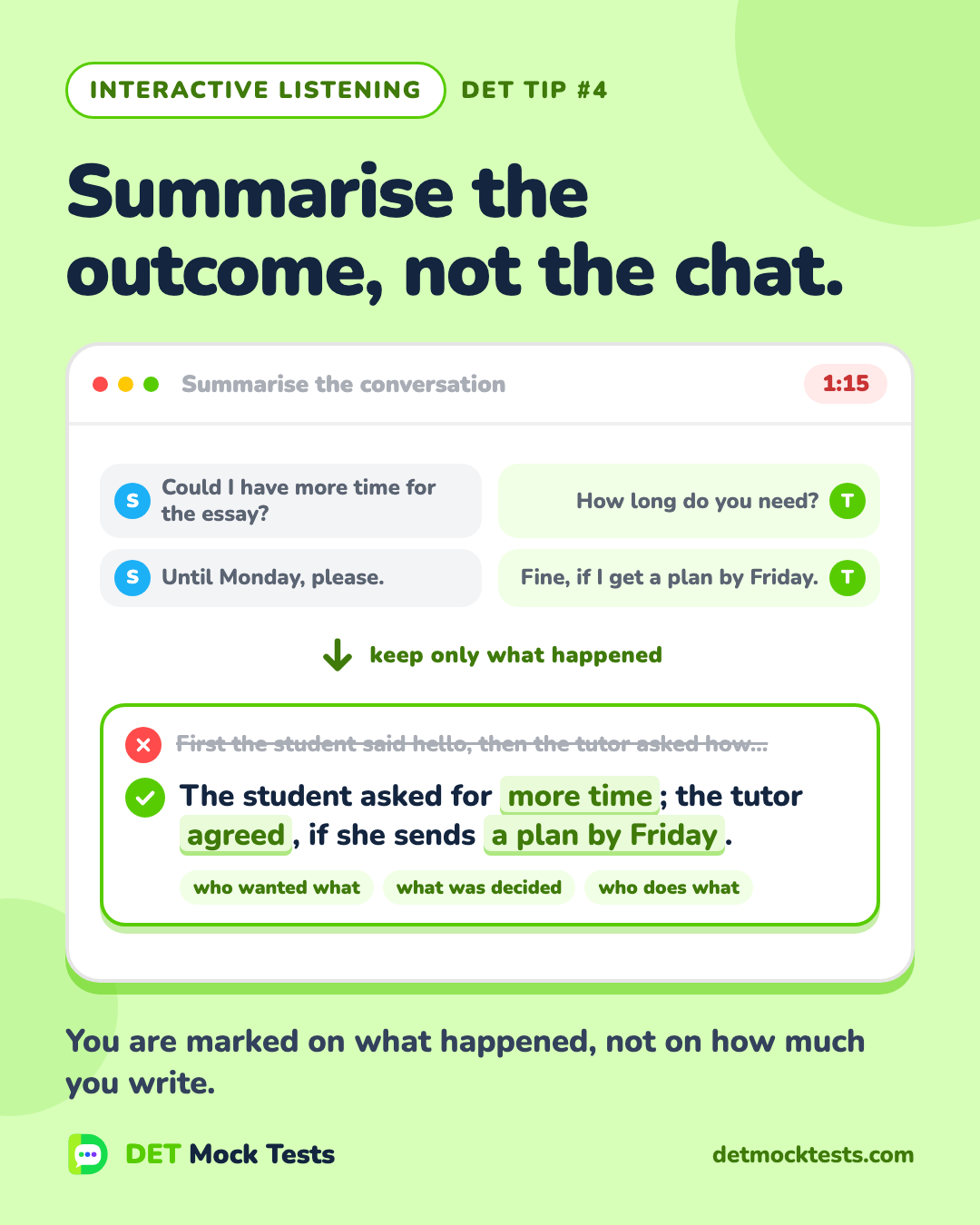
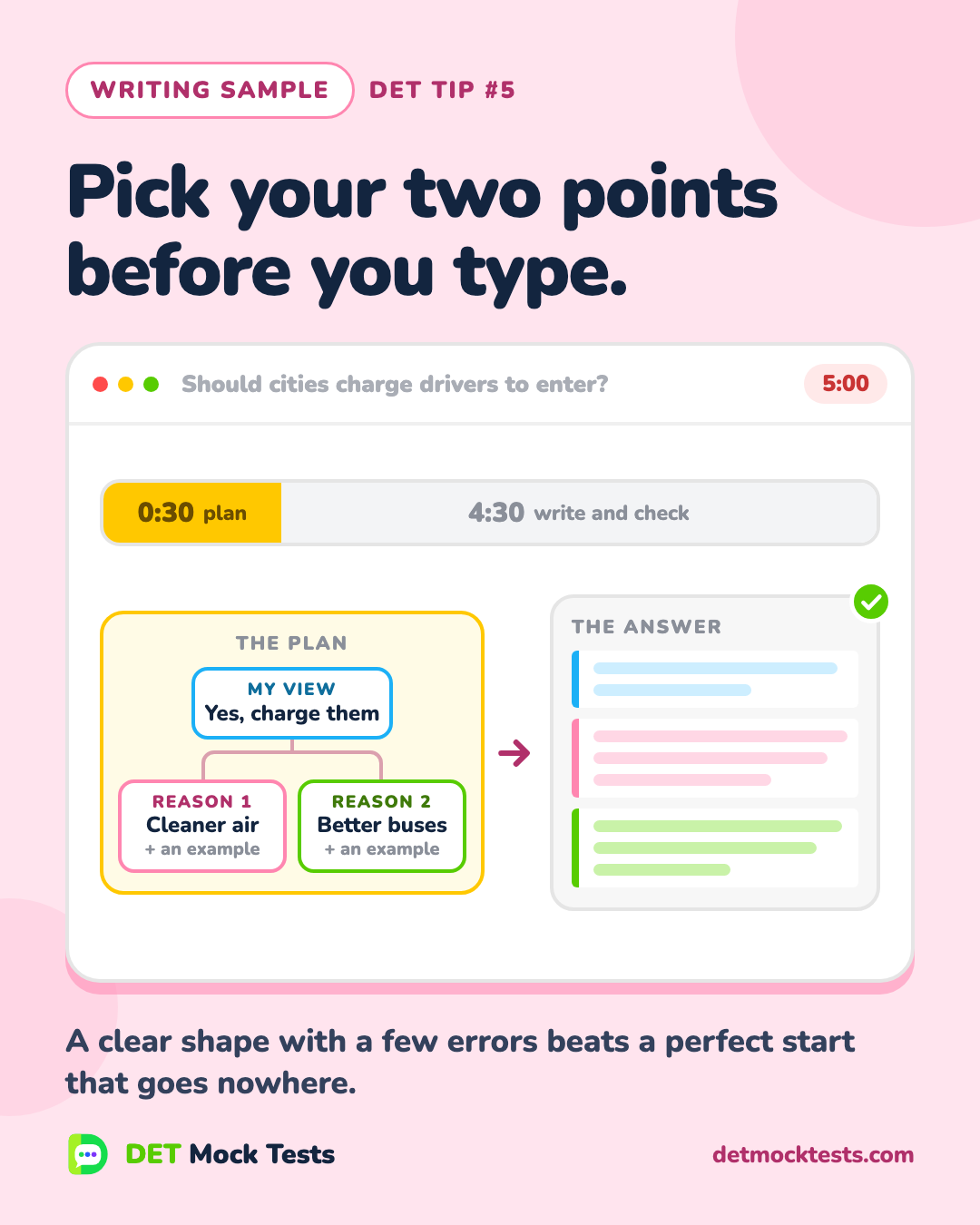
See all the Duolingo English Test tip cards, or read how to prepare for the test. Tip 4 matters most here: because you cannot go back, the best preparation is to meet every question type under the real clock in a full mock test before test day.
Exam-day checklist
Tick these off the night before and on the morning of the exam. Your ticks are saved on this device.
Walk into the DET already knowing the room.
Questions people ask
What are test-taking strategies?
Test-taking strategies are the methods you use to prepare for an exam and to work through it, so that your mark reflects what you know. They include learning the format, practising under timed conditions, sharing your time between questions, reading each question carefully, eliminating wrong options and checking your answers.
What are the 5 best exam tips?
First, learn exactly how the exam works. Second, revise by testing yourself, not by rereading. Third, sit at least two past papers under the real time limit. Fourth, in the exam, give each question its share of the time. Fifth, read every question twice before you answer. These five prevent most lost marks.
What is the best thing to do before taking a test?
The night before, pack what you need and sleep at your normal time. On the day, eat, drink water and arrive or log in half an hour early. In the last few minutes, do not learn anything new: look over a one-page summary, breathe slowly and decide how you will share out your time.
What should I do 30 minutes before an exam?
Stop studying new material. Read your summary sheet once, go to the toilet, drink some water and check you have everything. Avoid classmates who are panicking about what they have not revised. Then take five slow breaths, in for four and out for six, and remind yourself of your time plan.
How can I prepare for a test in one day?
Do not try to cover everything. Spend the first hour finding out what is most likely to be asked and what carries the most marks. Test yourself on those topics, write a one-page summary of each, do one timed past paper or as many questions as you can, and stop early enough to sleep properly.
Is C usually the right answer in multiple choice?
No. In a well-made test the correct answers are spread across the positions, often by computer, so no letter is more likely than another. If you have to guess, pick any option you have not ruled out and move on. Your time is better spent eliminating wrong options than looking for a pattern in the letters.
Should I change my answer or trust my first instinct?
Change it if you have a reason: you misread the question, remembered a fact or noticed a clue. Studies of answer-changing have found for decades that more changes go from wrong to right than from right to wrong. Do not change an answer only because you feel nervous about it.
Should I guess if I do not know the answer?
If wrong answers lose no marks, always answer: a blank is certain to score zero. If wrong answers lose marks, guess only when you can rule out at least one option, which tips the odds in your favour. Either way, eliminate first and guess second.
How do I manage my time in an exam?
Divide the minutes by the marks to get your time for each mark, after setting aside about ten minutes for reading and checking. Do the questions you find easy first if the exam allows it, check the clock at one third and two thirds of the time, and move on when a question’s time is used up.
How do I write answers to get full marks?
Give the answer in the first sentence, using the words of the question. Make one clear point for each mark, each in its own short paragraph with an explanation or an example. Use the subject’s key terms, number the answers as the paper does, and keep your writing easy to read.
How can I score good marks in an English exam?
For reading, answer only from the passage. For writing, plan for a minute and choose correct simple sentences over risky long ones. For grammar, find the subject and the time of each sentence first. Leave a few minutes to check verb endings, articles and spelling, which is where most English marks are lost.
What is the best way to study for exams?
Test yourself and spread your study out. A large 2013 review of study techniques rated practice testing and spaced practice as the most effective, and rereading and highlighting among the least. In practice: close the book, write what you remember, check it, and come back to the same topic a few days later.
How do I deal with exam nerves on the day?
Slow your breathing, with a longer breath out than in, for about a minute. Begin with a question you can answer to build momentum. If your mind goes blank, pause for ten seconds and write down anything you know about the question. Good preparation under timed conditions is the best long-term cure.
Do these strategies work for online and computer-based tests?
Most do: knowing the format, timed practice, reading carefully and eliminating options all carry over. Two change. Many computer tests time each question separately, and adaptive tests do not let you skip or go back, so you cannot do the easy questions first. Check your device, internet and room the day before.
What are the best tips for English proficiency tests like the Duolingo English Test?
Learn every question type before test day, because the test is timed and you cannot go back. Take a full mock test under real conditions, find your weakest skill and practise that. In speaking and writing, answer the question first and then add a reason and an example.
How many days before an exam should I start revising?
As early as you can, because the same hours work better spread out than packed together. For a major exam, several weeks of short daily sessions is ideal. If you have one week, study every day, test yourself each time, and do timed papers on at least two of the days.
Quick reference: Test-Taking Strategies at a glance
| Question | Answer |
|---|---|
| What are test-taking strategies? | Habits that turn what you know into marks: before, during and after the exam. |
| Best way to revise | Test yourself and spread the sessions out. Rereading and highlighting do least. |
| Most useful practice | Past papers or mock tests under the real time limit. |
| Time per question | Total minutes ÷ total marks = minutes per mark. |
| Before answering | Read the question twice and find the command word. |
| Multiple choice | Eliminate wrong options first; there is no “usual” letter. |
| Guessing | No penalty: answer everything. Penalty: guess only after ruling out an option. |
| Changing an answer | Change it if you find a real reason. First instinct is not safer. |
| Last 30 minutes before | Nothing new. Summary sheet, water, slow breathing. |
| On the Duolingo English Test | You cannot skip or go back, so each question gets your full attention once. |